Category: Porch Reflections

  • Lessons in Forgiveness and Humility

    Sometimes reconciliation does not arrive the way we expect it to.

    It does not always come with a formal apology or a carefully planned conversation. Sometimes it comes quietly, slowly, the way dawn comes. Almost without our noticing, and suddenly there is light where there was none before.


    The Hard Truth About Being Human

    We are all capable of causing pain we never intended to cause.

    We act from what we know, from what we see, from what we believe in the moment is right. And sometimes, even with the best of intentions, we wound someone. We set something in motion that we cannot take back. We make a decision that feels righteous in the moment and complicated in hindsight.

    I have been there more than once. If we are honest, so have you.

    The longer we walk this faith, the more convinced we become that God is far less interested in who was right and far more interested in what we do next.


    She did not demand an explanation nor did she did not ask me to justify myself or defend my actions. She simply said she wanted to put something out there. Maybe just something for me to reflect on.

    And then she said something I will not soon forget.

    I was hurt by it but I will leave it at the feet of Jesus.

    I did not have a response worthy of that moment and I am not sure one exists.

    Because what she offered me in that sentence was not just forgiveness. It was a masterclass in grace. She chose to set something heavy down rather than hand it back to me to carry. She chose the harder, holier path, not for my sake alone, but for her own freedom.

    That is not human nature. That is the Spirit of God moving in a person who has chosen, somewhere along the way, to let Him.


    What We Do Not Know About Each Other

    Here is something worth sitting with.

    We often form our opinions of people based on a small window of who they are. A moment, a season, a version of them we caught on a hard day, in a hard year, carrying things we knew nothing about.

    We see a behavior and we make a judgment. And sometimes that judgment is not wrong exactly, but it remains incomplete. Because people are always more than what we see in any single moment. They carry histories we have not been invited into. They fight battles that never make it into the room.

    I was a newcomer. She had been there for twenty five years. She knew every resident by name, by story, by preference. And I saw one thing, on one day, and I drew a conclusion.

    God has a way of humbling us gently when we need it. And sometimes the humbling comes through the very person we misjudged.


    We spent hours on the phone recently, she and I. Just talking, honestly and openly. The way two people talk when they decide that the relationship matters more than the wound.

    And somewhere in that conversation I remembered why I had connected with her. That does not disappear just because things get complicated. Sometimes it goes quiet for a season. But it does not disappear.

    Something sacred happens when two people choose to stay in the room. To work through the awkward silence and the unspoken apologies and the things that went unsaid for too long. To decide that restoration is worth more than being right.

    God put us back in the same room. And I believe He did it on purpose.


    Reconciliation does not always come. Not every relationship can or should be restored. Some situations require distance, boundaries, and wisdom.

    But when God makes a way, when He softens two hearts at the same time and creates an opening, something holy happens when we walk through it.

    We are able to lay down our version of the story long enough to hear someone else’s and receive grace as humbly as we hope to give it. We see that people are capable of more than the worst moment we witnessed in them.

    And it asks us to trust that God was working in the in-between, even when we could not see it. Especially when we could not see it.


    Lord, thank You for the people You put back in our path. For the second chances we did not earn and the conversations we did not know we needed. Thank You for the grace that comes through other people, unexpected, undeserved, and utterly like You.

    Forgive us for the times we acted from a place of certainty that was not as solid as we thought. Help us to hold our judgments loosely and our compassion firmly. Remind us that every person we encounter carries something we cannot see.

    And when You make a way for restoration, give us the courage and the humility to walk through it.

    For the woman who chose to leave it at the feet of Jesus, thank You for her. May she know today how deeply that mattered.

    Amen.


    Has God ever put you back in the same room with someone for a reason? What did restoration look like for you, and what did it ask of you to get there? We would love to hear your story in the comments.


  • The Balance Between Tools and Stillness

    The Balance Between Tools and Stillness

    I wrote this post about slowing down. Then I asked AI to help me do it faster.
    If that does not sum up the tension most of us are living in right now, I do not know what does.
    We talk about stillness, pin quotes about rest. We nod along when someone says we need to unplug. And then we pick up our phones before our feet hit the floor in the morning, fill every quiet moment with noise, and reach for the next tool that promises to help us do more in less time.
    I am not pointing fingers. I am looking in the mirror.

    What Are We Really Reaching For?
    Here is the question I have been sitting with lately. When I reach for a screen, a shortcut, a distraction, what am I actually reaching for?
    Sometimes it is efficiency. And that is fine. Tools are not the enemy. We use them, and that is okay.
    But sometimes, if I am honest, I am reaching for noise because the quiet feels like too much. Because sitting still means sitting with something I have not fully dealt with yet. Because presence requires something of me that busyness lets me avoid.

    The Still Small Voice
    In 1 Kings 19, the prophet Elijah was exhausted, overwhelmed, and hiding in a cave. God did not show up in the wind. Not in the earthquake. Not in the fire.
    He showed up in the still small voice.
    That phrase has stayed with me. Still. Small. Voice.
    Not a notification, a headline or a highlight reel. A whisper that requires us to be quiet enough to actually hear it.
    And I wonder sometimes how many still small voices we are scrolling right past.

    Tools or Crutches?
    I want to be clear about something. This is not a post about technology being bad. I use it every day. It helps me work, connect, create, and serve the people I care about. There is nothing inherently wrong with that.
    The question I keep coming back to is a matter of the heart.
    Is this tool serving my calling, or replacing the part of me that is supposed to show up?
    Am I using it to do good work more effectively, or am I using it to avoid the slower, quieter work that only happens when I put everything down and just be?
    There is a difference between a tool and a crutch. And only we know, in our most honest moments, which one we are holding.

    The Discipline of Putting It Down
    Stillness is not passive. It is one of the most countercultural, disciplined, intentional things we can choose in a world that rewards constant motion.
    It means choosing the slower path sometimes. The handwritten note instead of the quick text. The walk without earbuds. The morning that begins with Scripture before it begins with a screen. The prayer that is not rushed because something else is waiting.
    It means trusting that what grows in the quiet is worth more than what we produce in the noise.
    And it means being honest with ourselves when we are reaching for distraction and calling it productivity.


    Lord, forgive us for the quiet we keep filling. For the stillness we keep scrolling past. For the moments You were speaking and we were not listening because we were too busy doing.
    Teach us to put it down. Not perfectly, not all at once, but faithfully and with intention. Remind us that You are not found in the noise. Help us to be still enough, brave enough, and quiet enough to hear You when You whisper.
    And when we reach for the wrong thing, gently turn our hands back toward You.
    Amen

    Lastly, I wanted to share two morning devotionals that have genuinely anchored my own quiet time and helped me choose presence over noise. These are resources I use and love personally. Please note that the links below are affiliate links, which means I may receive a small fee if you purchase through them at no additional cost to you. I only share what I truly believe in, and these are no exception.

    Jesus Calling, Small Brown Leathersoft, with Scripture References: Enjoying Peace in His Presence (A 365-Day Devotional)

    The Divine Romance: 365 Days Meditating on the Song of Songs (The Passion Translation, Imitation Leather) – A Heartfelt Translation of the Song of Songs

  • Creating a Legacy: Small Moments That Matter

    Creating a Legacy: Small Moments That Matter

    They Didn’t Know They Were Teaching Us

    There was no curriculum.

    No lesson plan. No intentional moment where they sat us down and said, this is what matters. They just lived. And we watched.

    Our grandparents’ lives were shaped by things most of us will never fully know. Depression-era kitchens where nothing was wasted. Wars that took sons and changed the ones who came back. Faith practiced not as a feeling but as a discipline. Sunday clothes. Handwritten letters. Gardens that fed families because they had to.

    They didn’t call it resilience. They called it Tuesday.

    And somehow, in the watching, we learned.


    What Did We Take?

    Perhaps it was the way your grandmother’s hands moved without thinking. Kneading bread, snapping beans, folding laundry with a kind of quiet dignity that said this work matters. She wasn’t performing. She was providing.

    Or perhaps it was your grandfather’s word. The way he shook a hand and meant it. The way a promise wasn’t a suggestion.

    Either way, we took their grit without realizing we were picking it up. Their patience. Their ability to sit with hard things without needing to fix them in an hour.

    They knew how to wait. And in watching them wait, so did we.

    That generation understood something we are still trying to recover. That character is not built in the highlight moments. It is built in the accumulated weight of ordinary faithfulness. Showing up. Following through. Keeping the faith even when the faith costs something.

    We absorbed that. Maybe not all at once. Maybe not even consciously. But it is in us, whether we recognize it or not.


    Who Had the Most Influence?

    We each have an answer to that question, and it doesn’t always come wrapped neatly.

    Often, the most influential person in the room wasn’t the loudest. It was the one who stayed. The grandmother who showed up every Sunday. The grandfather who didn’t say much but was simply there, steady, consistent, immovable.

    Influence rarely announces itself. It settles quietly into the spaces between moments, and lives in the smell of a kitchen, the sound of a hymn sung under the breath, the sight of someone bowing their head before a meal without making a production of it.

    It lives in what was modeled more than what was spoken.

    And yet sometimes, if we’re honest, the family tree had broken branches. Maybe the grandparent we needed wasn’t available. There was distance, or silence, or pain where warmth should have been. Maybe the person who shaped us most wasn’t a grandparent at all. Maybe it was a neighbor, a Sunday school teacher, a coach, an aunt who stepped in without being asked.

    God is creative in how He places people in our paths.

    Even so, He was weaving something. Even in the gaps.


    What Did We Cling To?

    If the picture wasn’t perfect, and for many of us it wasn’t, we clung to the fragments.

    The one summer we spent with her. The way he laughed at the dinner table that one Christmas. A recipe written in shaky cursive on an index card. A phrase they repeated so often it became part of us.

    We make do. You’ll be alright. God is faithful.

    We clung to the glimpses. And in time, the glimpses were enough to build a foundation.

    Because God has a way of letting even imperfect people plant seeds in us that bloom long after they’re gone. He wastes nothing. Not the hard years, not the broken relationships, not even the losses we still carry. He takes what was given to us, however incomplete, and He works with it.

    That is grace.


    What We Carry Without Knowing It

    Here is something worth sitting with. We are more shaped by those who came before us than we often realize.

    The way you handle conflict and the way you respond to uncertainty and the way you talk about money, or struggle, or God. The way you love people when it is inconvenient.

    Some of what we carry is beautiful and some of it needs to be examined. Our part of the work of a maturing faith is learning to hold both with honesty.

    We are not prisoners of what we inherited but we are shaped by it. And knowing that changes how we live going forward.


    Now It’s Our Turn

    And so here’s the question that changes everything.

    What are we leaving behind?

    Not in a will. Not in a savings account. But rather in the lives of the people watching us right now. Because someone is always watching. A child. A younger coworker. A friend who is struggling and quietly taking notes on how we handle hard things.

    Legacy isn’t reserved just for grandparents. Legacy is being built right now, in the ordinary moments we don’t think anyone is paying attention to.

    The way we respond when things don’t go our way. How we speak about people who aren’t in the room. The way we show up when it costs us something.

    They are watching. And they are learning.

    Furthermore, it doesn’t require biological children to leave something that lasts. What about the coworker you encouraged on a hard day, the one who went home and told their spouse someone actually saw me today. Think about the friend you sat with in the waiting room, not because you had the right words but because you showed up anyway. Think about the younger person at church you took seriously when no one else did. The neighbor you checked on. The family member you refused to write off even when it would have been easier.

    Legacy is built in small, unremarkable moments that we will likely forget but they will be remembered.

    What Does It Look Like?

    Practically speaking, it looks like integrity when no one is grading you. When the decision is small enough that no one would ever know, and you still choose what is right.

    It looks like staying at the table when the conversation gets hard. Not walking away, not shutting down, but remaining present when presence is the most difficult thing to offer.

    It looks like admitting you were wrong. Humility is one of the most powerful things we can model, especially for younger people who have been taught that strength means never backing down. Showing them otherwise is a gift they may not recognize for years.

    Beyond that, it looks like faith that doesn’t evaporate when life gets heavy. Not perfect faith. Not tidy faith. But faith that keeps showing up. Faith that says I don’t understand this, but I still trust You. That kind of faith, witnessed up close, does something in a person that no sermon can fully replicate.

    It looks like the way we love people who are difficult to love. The way we choose kindness when we could choose something easier. The way we point people, quietly and consistently, toward something bigger than ourselves.

    And still, we may never know the full reach of what we leave. Just as our grandparents never knew that the way they kneaded bread or kept their word would echo forward decades later, we won’t always see what takes root in the people around us.

    But God sees it.

    And He is faithful to multiply what we offer, however small it feels in our hands. A few loaves. A few fish. Offered honestly. And watch what He does.


    Lord, thank You for the ones who came before us. The ones who shaped us without knowing it, who gave us more than they realized. For the grandmothers who prayed over us and the grandfathers who showed us what faithfulness looks like. And for those of us whose story had gaps, thank You for filling them in ways only You can.

    Now help us turn and face forward. Help us live in a way that leaves something worth finding. Not a perfect life, but a faithful one. Not a spotless record, but a consistent presence. The seeds we plant today be ones that bloom long after we are gone, in people we may never fully see.

    Help us to be, for someone else, exactly what we needed when we were young.

    Amen.


    Who shaped you without knowing it? Was it a grandparent, or someone who stepped in and filled that space? And what are you building right now in the people watching your life? You don’t have to have it all figured out to leave something that lasts. We’d love to hear your story in the comments.

  • Let Go of Worry: Embrace Peace in God’s Care

    Let Go of Worry: Embrace Peace in God’s Care

    Nobody sees it on you.

    And that is exactly the thing about quiet worry. It does not announce itself. It does not show up dramatically or demand attention. Instead it settles in somewhere behind your eyes and under your ribs and becomes so familiar that you almost forget it was not always there.

    You wake up with it and go to bed with it. It follows you through grocery store lines and dinner conversations and Sunday morning worship with a smile that nobody questions. In fact you have grown so skilled at holding it that most people in your life have no idea how heavy it actually is.

    But God sees it. Every single ounce of it.

    Psalm 55:22 says this: “Cast your cares on the Lord and He will sustain you. He will never let the righteous be shaken.”

    Cast. Not manage. Not organize. Not carry more efficiently. Cast.

    That word demands action. It is the posture of someone who decides the weight belongs somewhere else. Not because the worry is not real and not because the circumstances are not hard. But because God made His shoulders for exactly this and He did not make yours for it.

    The truth is God never designed us to carry chronic worry. He did not build our minds and bodies for the constant hum of low grade fear that so many of us have accepted as just the way things are. The sleeplessness. The tight chest. The what ifs that follow us from room to room. The rehearsing of conversations and outcomes that have not even happened yet. He never intended any of that for us.

    Because putting it down feels irresponsible. Stopping the worry feels like an open invitation for something to catch us off guard. And somewhere along the way we started believing that anxiety was just the price of loving people and living in an uncertain world.

    So can we gently challenge that today?

    Here is what we know. Worry has never changed a single outcome. It has never stopped a hard thing from happening or pulled a good thing any closer. What worry has done instead is rob countless people of the present moment they deserved to fully live. People who missed the ordinary graces of a Tuesday because they were already living in a terrible version of next month that never actually came.

    Jesus knew this about us. In Matthew 6 He asked the most tender and disarming question: “Can any of you by worrying add a single hour to your life?” He was not scolding us. Rather He was inviting us to notice the futility of the thing we grip so tightly. Then He pointed us to the birds and the flowers and a Father who holds all of it without forgetting a single sparrow.

    And He has not forgotten you either.

    The thing you quietly carry today – the relationship hanging in uncertainty, the health concern you have not told anyone about, the financial pressure you smile through, the future that feels like standing at the edge of something you cannot see – He knows it. He knew it before you opened your eyes this morning. And still He has not left it unattended.

    Here is what casting looks like in real life. It is not a one time event. We practice it daily. Sometimes moment by moment. Our hands open and release what we are gripping and every single time God meets us right there. Not always with answers. Not always with the resolution we wanted. But always with His presence. And ultimately His presence sustains us when the circumstances refuse to move as fast as we hoped.

    So today we come to the porch with open hands.

    We name the thing we have been quietly carrying. We do not dress it up or minimize it or pretend it weighs less than it does. Instead we bring it exactly as it is and lay it at the feet of the One who said come to me all who are weary and I will give you rest.

    And then we breathe.

    Because we were never meant to hold this weight forever. It always belonged to Him.


    Lord, You see the worry we carry in the quiet places. The weight nobody else knows about. The fear that grew so familiar we almost stopped noticing it. And yet You have seen it all along. Today we choose to cast. Our hands open wide. We release what we have been gripping and trust that You are not surprised by any of it. Your shoulders hold what ours were never built to carry. Sustain us today as only You can. Give us the grace to breathe and the courage to trust. Remind us again that You have never once dropped what we place in Your care. In Jesus name, Amen.


    What are you carrying today that you need to lay down? The porch is a safe place. We would love to hear from you in the comments.

  • Finding Hope in Suffering: A Gentle Conversation

    Finding Hope in Suffering: A Gentle Conversation

    We need to talk about something hard today on the porch.

    Not with a pointed finger. Not with a raised voice. But with the kind of honesty that only comes when we trust each other enough to sit in the uncomfortable places together.

    Because some of you reading this are suffering in ways that most people around you cannot see. Physical pain that does not stop. Emotional pain that has gone on so long you have forgotten what it felt like before it was there. And somewhere in the quiet of your hardest moments the thought has crossed your mind that maybe ending it on your own terms is the most merciful choice left.

    We are not here to shame that thought. We are here to sit with you in it.

    Assisted suicide is becoming more widely accepted in our culture and more legally available in many places. And we understand why. When someone we love is suffering without relief, when the body is failing and the pain is relentless, the desire to end that suffering feels like an act of compassion. The heart behind it is not wicked. It is human.

    But we believe something different about suffering. And we want to share it gently.

    Psalm 139:16 tells us that every day of our lives was written in God’s book before one of them came to be. Not just the good days. All of them. The hard ones. The ones that feel impossibly long. The ones where we are holding on by a thread we cannot even see anymore. Those days were known by God before we lived them and He has not abandoned us in them.

    Job knew suffering that most of us will never touch. He lost everything – his children, his health, his livelihood, his dignity. He sat in ashes and scraped his wounds with broken pottery. And he said things to God that would make a lot of Sunday morning congregations uncomfortable. He was raw and angry and desperate. But he did not let go of God nor did God let go of him.

    The sanctity of life is not a rule God made to make our suffering longer. It is a reflection of something profound – that our lives belong to Him. That we are not accidents. That even in the valley of the shadow of death He is there. Psalm 23 does not say He removes the valley. It says He walks through it with us.

    We also want to speak to the one whose suffering is not physical. The one whose pain lives in the mind and the soul. Depression lies. It tells you that you are a burden, that things will never change, that the people around you would be better off. None of that is true. Not one word of it. And the fact that you are still here, still reading, still breathing means the story is not over.

    Romans 8:38-39 says that nothing -not death, not life, not things present, not things to come -can separate us from the love of God. Nothing you are feeling right now has moved you outside the reach of that love. Not your darkest thought or your longest night. Not the pain that has no name.

    We do not have easy answers for suffering. The porch has never been a place for easy answers. But we do have a God who entered human flesh specifically so He could know what it felt like to hurt. Jesus wept and Jesus bled. Jesus cried out from the cross asking why God had forsaken Him. He is not unfamiliar with your pain. He wore it.

    If you are in a dark place today please do not navigate it alone. Tell someone. Reach out. There are people whose whole purpose is to sit with you in this.

    988 Suicide and Crisis Lifeline: Call or text 988, available 24 hours a day, 7 days a week.

    You are not a burden. You are not beyond hope. And this porch will always be a place where you are welcome exactly as you are, in whatever you are carrying today.

    We see you. God sees you and we are so glad you are here.


    Lord, we bring You the ones who are suffering today in ways we cannot fully see or understand. The ones whose bodies are failing them and the ones whose minds will not give them rest. The ones who are so tired of hurting that they are considering options that break our hearts. Meet them right there and let them feel You closer than their next breath. Give them one reason to hold on today. And tomorrow give them one more. Remind them that their life is written in Your hand and You are not finished with their story. Surround them with people who will sit with them in the dark and not run from it. In the precious name of Jesus, Amen.


    If someone you love is struggling today, will you share this post with them? And if you are the one struggling, we are here. You are not alone.

  • Life Lessons from Nature: Trust and Provision

    Life Lessons from Nature: Trust and Provision

    “But ask the animals, and they will teach you.” Job 12:7

    I wasn’t expecting a theology lesson on a Monday morning. But there they were, two fox kits tumbling across the church lawn in the golden early light, their father trotting just ahead, steady and sure. I stood still and watched longer than I probably should have.

    And I listened.

    There is something about witnessing new life in the middle of an ordinary week that quietly rearranges you. Spring has a way of doing that, arriving uninvited into our routines and reminding us that the world is still being tended.

    “Look at the birds of the air; they do not sow or reap or store away in barns, and yet your heavenly Father feeds them.” Matthew 6:26

    Jesus said birds. But I think He meant fox kits too.

    These little ones have no awareness of what lies ahead, the summer heat, the eventual scattering that comes with autumn, the wide world waiting beyond the den. They only know this morning. This grass. This father leading them forward. And somehow, that is enough.

    Isn’t that what we are invited into? Not mastery of the future, but trust in the One who holds it.

    I have been watching this family for a few weeks now. The mother, quieter and less visible, working faithfully behind the scenes. The father, steady in his provision, showing up day after day. The kits, growing stronger, venturing a little further each time, not because they have figured everything out, but because they are held.

    “He will cover you with his feathers, and under his wings you will find refuge.” Psalm 91:4

    That image of covering – of shelter that doesn’t remove us from the world but sustains us within it, is exactly what I watched play out on that church lawn. The kits are not hidden away forever. They are being prepared. Covered. Sent out in due season.

    Seasons change. They always do. What looked like winter gives way to something new. And God, faithful as ever, is already out ahead of us, steady and sure, just like that father fox trotting across the morning grass.

    A Moment to Reflect:

    When did you last pause long enough to let creation speak to you? What did you notice?

    Where in your life are you being asked to trust the One who is out ahead of you, even when you cannot see the full path?

    Lord, thank You for the ordinary mornings that turn out to be anything but ordinary. Thank You for fox kits and golden light and the quiet ways You remind us that You are still tending this world and us. Where we are anxious about what lies ahead, cover us. Where we have forgotten to look up, open our eyes. You are faithful in every season. We trust You with this one too.

    Amen.

  • Honoring All Mothers: A Careful Look at Grief and Joy

    Honoring All Mothers: A Careful Look at Grief and Joy

    Mother’s Day is coming.

    The stores know it. The commercials know it. The flower shops and the brunch menus and the greeting card aisles all know it. And for some of us that is a beautiful thing. A reason to celebrate, to gather, to say out loud what we sometimes forget to say the other 364 days of the year.

    But we want to sit on the porch today with the mothers the commercials forget.

    We want to sit with the woman who is scrolling through her phone this weekend seeing everyone else’s celebrations while her arms still remember the weight of the baby she never got to bring home. The one who painted a nursery and chose a name and loved with her whole heart before the world ever had a chance to know. You are a mother. Your grief is real. And God has not forgotten the child He knew before you did.

    Psalm 34:18 says “The Lord is close to the brokenhearted and saves those who are crushed in spirit.” He is not far from you this weekend. He is closest to you right where the ache is deepest.

    We want to sit with the woman who lost her mother this year. Or ten years ago. Or thirty years ago and still reaches for the phone on Mother’s Day before remembering. Grief does not follow a calendar and love does not have an expiration date. Missing her is not weakness. It is the evidence of something that mattered.

    We want to sit with the mother whose adult children are busy. Or distant. Or difficult. The one who raised them, poured herself into them, prayed over them in the dark, and now waits for a text that comes late or not at all. The one who would never say it out loud but carries a quiet wondering about whether any of it mattered.

    It mattered. Every sleepless night mattered. Every prayer mattered. Every sacrifice that no one saw and no one thanked you for mattered. Galatians 6:9 reminds us “Let us not become weary in doing good, for at the proper time we will reap a harvest if we do not give up.” Your harvest is coming. Do not give up on them.

    And we want to sit with the mother in the nursing home. The one in the chair by the window on Sunday afternoon watching the parking lot. The one whose hands still remember rocking babies even when her mind can no longer recall their names. The one whose children mean to visit and keep meaning to visit and somehow Sunday comes and goes and the chair by the window stays empty.

    She is still a mother. Her love did not diminish when her memory did. And if no one comes this Sunday we pray she feels the presence of the One who never leaves. Isaiah 46:4 promises “Even to your old age I am He, and to gray hairs I will carry you. I have made and I will bear. I will carry and will save.” He carries what we cannot carry. He remembers what the mind forgets. He sits in the chair beside her even when we do not.

    Mother’s Day is joyful and we do not want to take that from anyone. But joy and grief live in the same house sometimes. And the truest thing we can do on a day like this is make room for both.

    So if you are celebrating this weekend, celebrate fully. And if you are grieving this weekend, grieve honestly. And if you are somewhere in between, holding joy in one hand and sorrow in the other, you are in very good company on this porch.

    You are seen. You are known. You are loved by a God who called Himself a comforter, who compared His own love to that of a mother who cannot forget her nursing child, who said even if she forgets, I will not forget you.

    He has not forgotten you. Not today. Not ever.

    Happy Mother’s Day to every kind of mother. Every kind of daughter. Every woman carrying something tender this weekend.

    We see you.

    Lord, this weekend we bring You every mother who is hurting. The ones grieving babies they never got to hold. The ones missing mothers they can no longer call. The ones waiting by the phone for children who have grown distant. The ones sitting by windows in quiet rooms hoping someone remembers. Meet them where they are. Let them feel Your presence so close it feels like arms around them. Remind them that they are seen and known and deeply loved by You. And for every mother celebrating this weekend, multiply their joy. In Jesus’ name, Amen.


    Whatever this Mother’s Day holds for you, we are glad you are here on the porch. Will you share how we can pray for you this weekend in the comments?

  • Finding Strength in Weakness: The Beauty of Real Faith

    Finding Strength in Weakness: The Beauty of Real Faith

    Pablo Picasso once said, “Good taste is the enemy of great art.”

    He was talking about painting. But sit with that for a moment on the porch and see if it doesn’t say something true about faith too.

    Good taste is about refinement. About knowing what belongs and what doesn’t. About edges that are clean and surfaces that are smooth and nothing too raw or uncomfortable left showing. Good taste keeps everything presentable.

    But art is not about presentable. Art is about human. And human is messy.

    So is the gospel.

    We have spent a great deal of energy in the church making Christianity tasteful. Polished testimonies with tidy endings. Struggles that are always safely in the past tense. Prayers that sound composed. Faces that look like they have it together. We have refined the faith until it gleams and somewhere in all that polishing we have lost the thing that makes it real.

    Here is what we know to be true: you are not useless to God because you are broken. You are useless to God if you pretend you are not.

    The most powerful moment in all of Scripture may be the one that takes place in a garden before dawn, when a woman named Mary Magdalene stands outside an empty tomb and weeps. She is not composed. She is not refined. She has nothing left. The one she loved is gone and she doesn’t even know where they have put him. She is, by every measure, a mess.

    And into that mess, Jesus speaks her name.

    Not the cleaned-up version of her name. Not the Mary she was trying to become. Her name. As she was. Standing there undone in the early morning dark.

    And she became the first witness to the resurrection. Not a theologian. Not a Pharisee with impressive credentials. A broken woman who showed up weeping and met the risen Christ in her mess.

    That is not an accident. That is the whole story.

    Paul understood this. He wrote from his own unresolved weakness in 2 Corinthians 12:9 “My grace is sufficient for you, for my power is made perfect in weakness.” Not after the weakness is resolved. Not once you have worked through it. In it. The power of God shows up most clearly in the places we have stopped pretending are fine.

    God is not looking for refined. He is looking for real.

    He takes the jagged edges and the unfinished places and the parts of us we would never put on display and He makes something out of them that good taste never could. He is less interested in our polish than our surrender. Less moved by our composure than our honesty. He has always done His best work in the mess.

    The clay on the ground. The tears in the garden. The cross on the hill.

    None of it was tasteful. All of it was holy.

    So we lay down the performance this morning. We stop smoothing the edges long enough to let God work with what is actually there. We bring the unfinished, unresolved, unpolished version of ourselves to the porch and we let that be enough.

    Because it is. It always has been.


    Lord, forgive us for the energy we spend trying to look like we have it together. For the testimonies we rehearse and the struggles we hide and the prayers we dress up before we bring them to You. Today we come as we are. Messy and real and trusting that Your power shows up best in exactly this kind of weakness. Make something beautiful out of what we have been too ashamed to show You. In Jesus’ name, Amen.

  • Golden Tempo: A Kentucky Derby Underdog’s Triumph

    Golden Tempo: A Kentucky Derby Underdog’s Triumph

    Nobody saw it coming. That is the whole point.

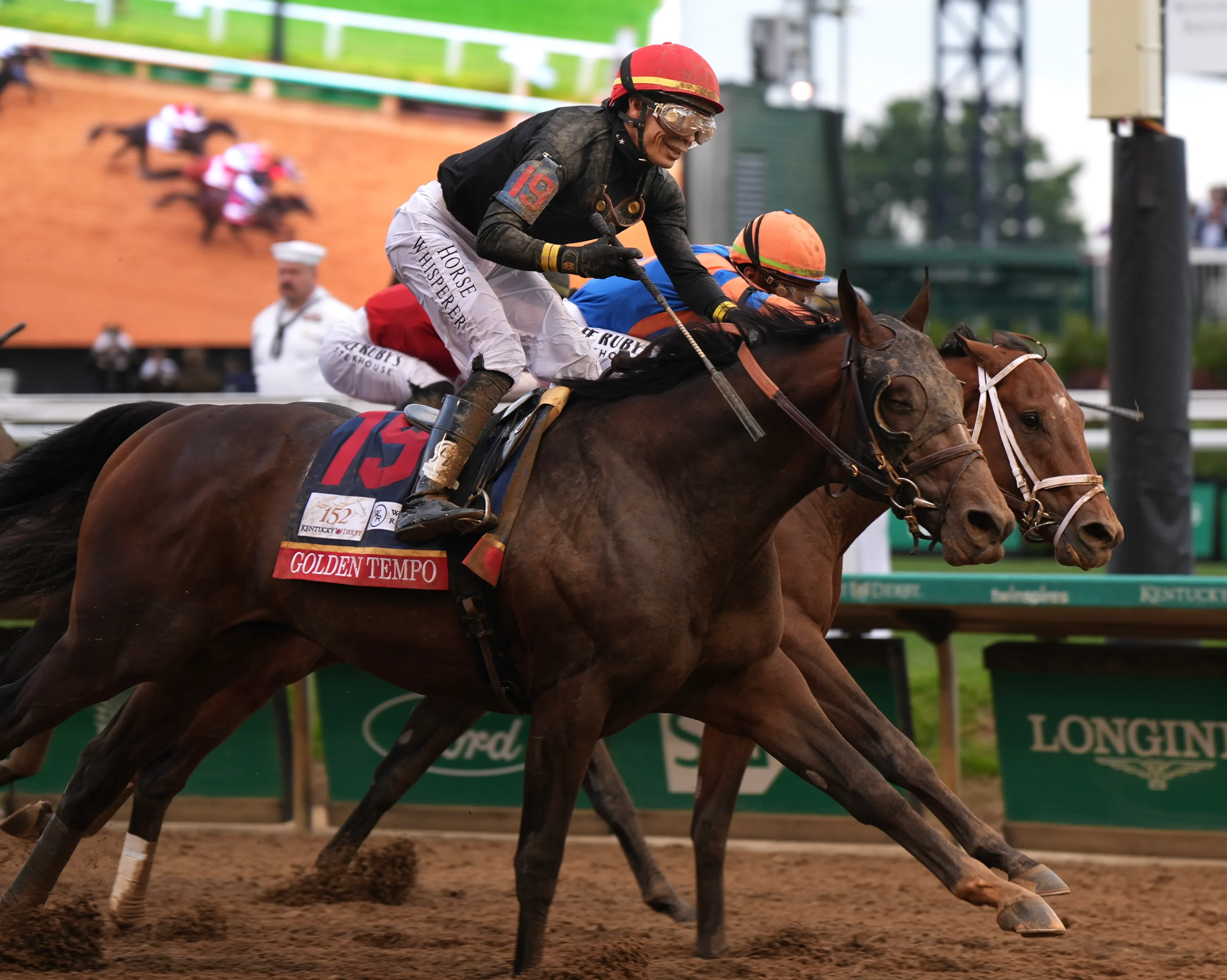
    On Saturday at Churchill Downs, a bay colt named Golden Tempo lined up with 17 other horses for the 152nd running of the Kentucky Derby. His odds were 23-1. Three quarters of a mile into the race he was sitting in dead last. Nineteenth out of nineteen horses. By every measure the story was already written and Golden Tempo was not in it.

    And then something happened.

    Guided by jockey José Ortiz, Golden Tempo weaved through the field, charged down the stretch, and overtook the race favorite Renegade in the final moments to win the Kentucky Derby. The crowd erupted. Tears fell. History was made.

    Trainer Cherie DeVaux became the first woman in history to train a Kentucky Derby winner. Standing in the winner’s circle with her husband, her sister, her daughter, and her young nephew Maverick in her arms, she wept. When asked what it felt like she said simply: “I’m just glad that I could be a representative of all women everywhere that we can do anything we set our minds to.”

    And if that were not enough, José Ortiz edged out his own brother Irad Ortiz Jr., who was riding Renegade, in the final stretch. The brothers exchanged a fist bump after crossing the finish line. Brother against brother. Grace between competitors. A fist bump that said everything words could not.

    We sat and watched all of that unfold on a Saturday afternoon and something in us recognized it. Not just as a great race. As a parable.

    Because is that not exactly how God works?

    He starts with the one nobody is watching. The longshot. The one sitting in last place three quarters through the race of their life. The one the world has already counted out. And then in His timing, not ours, He moves.

    Hebrews 12:1 tells us to “run with endurance the race that is set before us.” Not the race we planned. Not the race where we started in front. The race that is set before us. The one with the unexpected turns and the moments of dead last and the stretches where we cannot see how any of it ends well.

    Golden Tempo did not know he was making history. He just ran.

    Cherie DeVaux did not stand in that barn for years thinking about being the first woman to win the Kentucky Derby. She just trained her horse and trusted the work and showed up every morning before dawn in dusty boots doing what she was called to do.

    That is faithfulness. And faithfulness, in God’s economy, always finds its moment.

    Micah 6:8 calls us to walk humbly. Not to announce ourselves. Not to demand our moment. To walk humbly and trust the One who numbers our steps. DeVaux walked humbly into that winner’s circle and the moment found her.

    And José Ortiz, who had just won the Kentucky Oaks the day before and then the Derby itself, when asked about beating his own brother said: “I want him to win the Derby of course. I know it’s his dream as well.” Not a word of boasting. Just grace for the brother who ran alongside him and came in second.

    That is 1 Corinthians 13 with a jockey’s silks on.

    We do not always know where we are in the race. We do not always know if we are in last place or closing ground or closer to the finish than we think. But we know Who holds the outcome. We know Who sees what the crowd cannot see. We know that dead last at the three quarter mark is not the final word when God is writing the story.

    Golden Tempo. A name that sounds almost like a prayer. A golden rhythm. A pace set by something deeper than odds or expectation.

    May we all run like that today.


    Lord, You have always chosen the longshot. The last. The overlooked. The one nobody was watching. Remind us today that You see exactly where we are in the race and You are not worried. Teach us to run with endurance, to walk in humility, and to cross every finish line with a fist bump for the ones who ran beside us. And when the moments of history find us, expected or not, may our first words always be Yours. To You be all the glory. In Jesus’ name, Amen.


    Where in your life has God surprised you by showing up when you felt like you were in last place? We would love to hear from you in the comments.

  • Understanding God’s Unconditional Love

    Understanding God’s Unconditional Love

    There is a scene in the film Ragamuffin that is worth pausing the movie for. Rich Mullins is in a car, somewhere in the dark, running from himself the way he often did. His friend slips a cassette tape into the player and the voice of Brennan Manning fills the car. And something in Rich Mullins breaks open.

    The words Manning spoke that night were not complicated. They were not a theological argument or a carefully constructed sermon outline. They were simply this:

    “I dare you to trust that I love you, just as you are. Not as you should be. Because none of us are as we should be.”

    Rich Mullins wept. And perhaps we understand why.

    We spend so much of our lives trying to become someone God could finally be proud of. We clean ourselves up before we pray. We confess before we come close. We perform and we strive and we exhaust ourselves in the pursuit of a version of ourselves that feels worthy of being loved. And all the while, the God of the universe is waiting at the door of our heart saying the same thing He has always been saying: come as you are.

    Manning spent his lifetime preaching one sermon in a thousand different ways. He believed that the central question of the Christian life was not “Are you good enough?” but rather the question Jesus Himself will ask on the last day. Manning put it this way:

    “I am utterly convinced that on Judgment Day the Lord Jesus is going to ask each of us one question and only one question: Did you believe that I loved you? That I desired you? That I waited for you day after day? That I longed to hear the sound of your voice?”

    That question lands differently depending on where we are sitting when we hear it.

    For some of us it lands like relief, like finally being seen. For others it lands like a quiet conviction because if we are honest, we have heard about the love of God our whole lives and never quite let it reach the deep places. We have nodded at it from a safe distance. We have agreed with it theologically while quietly believing in our hearts that it applies to everyone except us.

    Manning called this out with a grace that never felt like shame. He said the real believers would answer yes. But many faithful churchgoers, many dutiful sermon-givers, many consistent tithers would have to quietly reply: “Well, frankly, no sir. I never really believed it.”

    There is the difference. Not between the righteous and the wicked. Between those who received the love and those who kept it at arm’s length.

    Zephaniah 3:17 tells us that God rejoices over us with singing. Not tolerates us. Not endures us. Rejoices. The God who spoke the mountains into existence quiets Himself over us with love and breaks into song. That is not the God of our low self-esteem. That is not the God we have made in the image of our most critical inner voice.

    Manning said it with the kind of plainness that stops us in our tracks: “I could more easily contain Niagara Falls in a teacup than I can comprehend the wild, uncontainable love of God.”

    The wild, uncontainable love. Not the love that waits for us to get it right. Not the love that keeps score. The love that was already running toward us while we were still a long way off.

    The question is not whether God loves us. The question Manning dared us to answer is whether we believe it. Whether we have let it past the front door of our hearts and into the rooms we are most ashamed of. Whether we have allowed it to be the loudest voice in the room.

    Rich Mullins believed it eventually. Imperfectly, messily, with tears in a car on a dark road, but he believed it. And it changed everything about the music he made and the life he lived and the way he loved people on the fringes.

    We can believe it too. Not because we have earned it or figured it out, but because the invitation has never been rescinded. It is still standing. It was standing before we woke up this morning and it will be standing long after we close our eyes tonight.

    Do you believe that He loves you?

    Not as you should be. As you are. Right now. On this ordinary day. In this imperfect life. With everything you are carrying and everything you have done and everything you wish you could undo.

    He loves you. He has always loved you. And He is not finished yet.


    Father, forgive us for the ways we have kept Your love at a safe distance. For believing in it with our minds while guarding against it with our hearts. Today we open the doors we have kept closed. We receive what we cannot earn. We trust what we cannot fully understand. We say yes to the question You are asking. Yes, Lord. We believe that You love us. And we are letting that change everything. In Jesus’ name, Amen.


    Has there been a moment in your life when the love of God finally felt real to you?