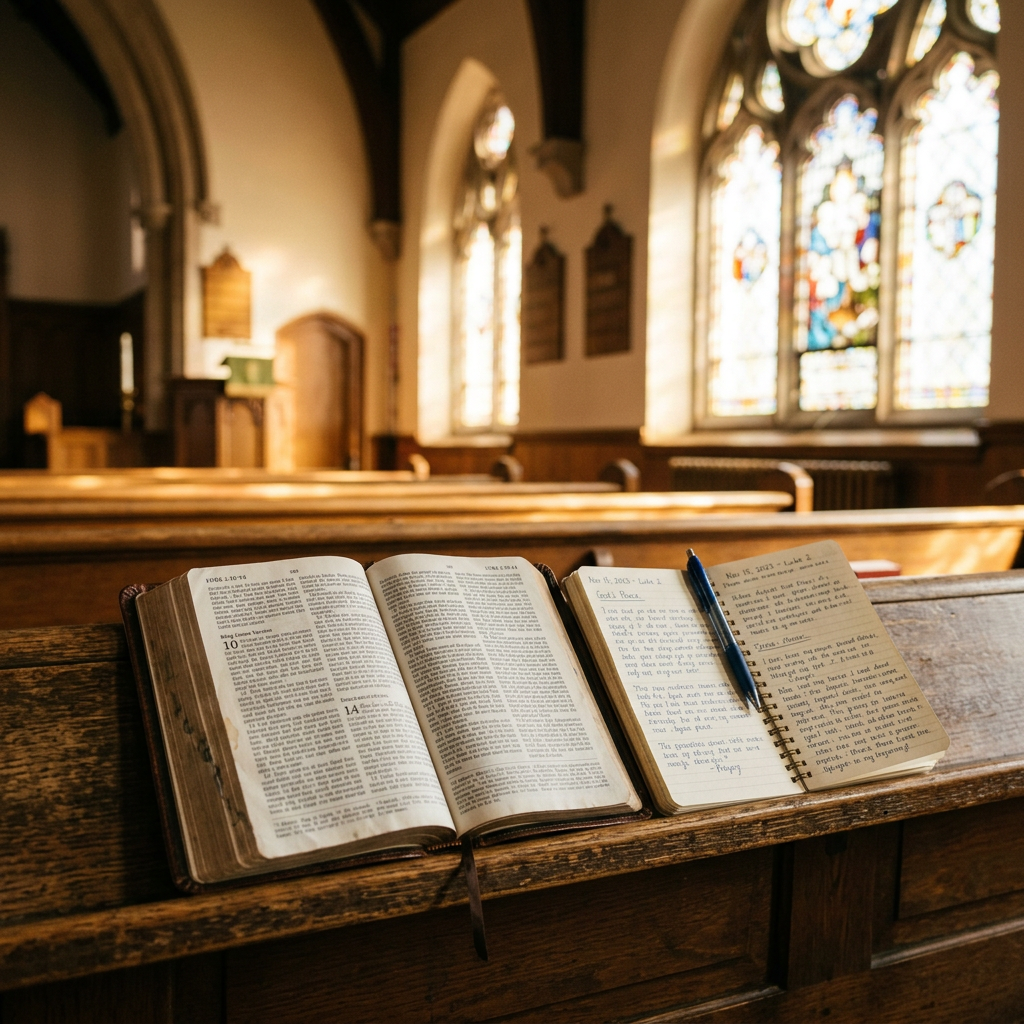
Tag: bible

  • Compassion: The Heart of Jesus’ Teachings

    Compassion: The Heart of Jesus’ Teachings

    He got into one of the boats, which was Simon’s, and asked him to put out a little from the land. And He sat down and taught the multitudes from the boat.” Luke 5:3


    I don’t always understand the words spoken at Polish Mass. The rhythm of the language washes over me like water – familiar in sound, foreign in meaning and yet something still arrives. Something settles in the heart that doesn’t need a perfect translation.

    This past Sunday, I sat with my notebook open and caught what I could. One phrase came through clearly enough to write down: Jezus uczynił wszystko z litości. Jesus did everything out of compassion.

    The priest was speaking about Luke 5, the scene at the Lake of Gennesaret where the crowd pressed so close that Jesus stepped into Simon’s boat and pushed out from shore. He sat down – teachers sat in those days when they were about to say something important and He taught the people from the water.

    Out of compassion.

    I find myself turning that phrase over slowly, the way you might turn a stone in your palm. Not Jesus taught because it was His duty. Not Jesus taught because the crowd demanded it. But because something moved in Him when He looked out at those people gathered at the water’s edge, hungry and leaning in. Compassion isn’t a policy. It isn’t a method. It’s a movement of the heart.

    And here is what strikes me: He didn’t wait for a more suitable moment. There was no pulpit, no prepared room, no ideal setting. There was a borrowed boat, a tired fisherman, and a crowd that needed something He had to give. So He used what was available. He taught from where He was.

    I wonder sometimes if we wait too long for the right conditions before we offer what we have. Before we speak what we know to be true, before we reach toward someone, before we let my faith do something visible in the world. I tell myself the moment isn’t quite right and we need to be more prepared.

    But compassion doesn’t wait for the right conditions. Compassion sees the crowd and gets in the boat.

    I couldn’t follow every word of that homily. But somehow, in the gap between languages, this is what I heard: Jesus did everything out of compassion. Even this, the teaching, the reaching. All of it was moved by love, not obligation.

    Maybe that’s the quietest and most revolutionary thing about Him.


    Lord, move me the way You moved. Not out of duty or performance, but out of something genuine and tender. When I see someone leaning in – hungry, waiting, hoping – let compassion be what gets me in the boat. Amen.


    Have you ever received something meaningful in an unexpected setting – a place or a moment where you didn’t expect to hear from God? I’d love to hear about it in the comments.

  • Finding Hope in Suffering: A Gentle Conversation

    Finding Hope in Suffering: A Gentle Conversation

    We need to talk about something hard today on the porch.

    Not with a pointed finger. Not with a raised voice. But with the kind of honesty that only comes when we trust each other enough to sit in the uncomfortable places together.

    Because some of you reading this are suffering in ways that most people around you cannot see. Physical pain that does not stop. Emotional pain that has gone on so long you have forgotten what it felt like before it was there. And somewhere in the quiet of your hardest moments the thought has crossed your mind that maybe ending it on your own terms is the most merciful choice left.

    We are not here to shame that thought. We are here to sit with you in it.

    Assisted suicide is becoming more widely accepted in our culture and more legally available in many places. And we understand why. When someone we love is suffering without relief, when the body is failing and the pain is relentless, the desire to end that suffering feels like an act of compassion. The heart behind it is not wicked. It is human.

    But we believe something different about suffering. And we want to share it gently.

    Psalm 139:16 tells us that every day of our lives was written in God’s book before one of them came to be. Not just the good days. All of them. The hard ones. The ones that feel impossibly long. The ones where we are holding on by a thread we cannot even see anymore. Those days were known by God before we lived them and He has not abandoned us in them.

    Job knew suffering that most of us will never touch. He lost everything – his children, his health, his livelihood, his dignity. He sat in ashes and scraped his wounds with broken pottery. And he said things to God that would make a lot of Sunday morning congregations uncomfortable. He was raw and angry and desperate. But he did not let go of God nor did God let go of him.

    The sanctity of life is not a rule God made to make our suffering longer. It is a reflection of something profound – that our lives belong to Him. That we are not accidents. That even in the valley of the shadow of death He is there. Psalm 23 does not say He removes the valley. It says He walks through it with us.

    We also want to speak to the one whose suffering is not physical. The one whose pain lives in the mind and the soul. Depression lies. It tells you that you are a burden, that things will never change, that the people around you would be better off. None of that is true. Not one word of it. And the fact that you are still here, still reading, still breathing means the story is not over.

    Romans 8:38-39 says that nothing -not death, not life, not things present, not things to come -can separate us from the love of God. Nothing you are feeling right now has moved you outside the reach of that love. Not your darkest thought or your longest night. Not the pain that has no name.

    We do not have easy answers for suffering. The porch has never been a place for easy answers. But we do have a God who entered human flesh specifically so He could know what it felt like to hurt. Jesus wept and Jesus bled. Jesus cried out from the cross asking why God had forsaken Him. He is not unfamiliar with your pain. He wore it.

    If you are in a dark place today please do not navigate it alone. Tell someone. Reach out. There are people whose whole purpose is to sit with you in this.

    988 Suicide and Crisis Lifeline: Call or text 988, available 24 hours a day, 7 days a week.

    You are not a burden. You are not beyond hope. And this porch will always be a place where you are welcome exactly as you are, in whatever you are carrying today.

    We see you. God sees you and we are so glad you are here.


    Lord, we bring You the ones who are suffering today in ways we cannot fully see or understand. The ones whose bodies are failing them and the ones whose minds will not give them rest. The ones who are so tired of hurting that they are considering options that break our hearts. Meet them right there and let them feel You closer than their next breath. Give them one reason to hold on today. And tomorrow give them one more. Remind them that their life is written in Your hand and You are not finished with their story. Surround them with people who will sit with them in the dark and not run from it. In the precious name of Jesus, Amen.


    If someone you love is struggling today, will you share this post with them? And if you are the one struggling, we are here. You are not alone.

  • Finding Stillness: Embracing God’s Invitation to Rest

    Finding Stillness: Embracing God’s Invitation to Rest

    There are seasons when God does not ask us to figure it out. He simply asks us to show up.

    We have been there – haven’t we? We move through our days perform our faith, perform our marriages, perform our lives and check the boxes. Saying the right things. Keeping it together for everyone who is watching. Sound familiar?

    And then, quietly, God points to a little place.

    Maybe it is a stretch of coastline where the waves do not care how well you are doing. Maybe it is a chair by a window with a view that asks nothing of you. Maybe it is simply the seat beside someone you love, with nowhere to be and nothing to prove.

    He leads us there not because we have earned the rest but because we need it.

    Be still and know that I am God. Psalm 46:10

    Not to be productive. Not to be impressive. Not to be healed by next week. Just to be still.

    There is a kind of restoration that only happens when we stop performing. When we let the ocean be loud so we can be quiet. When we sit and simply breathe. When we let God be God and release ourselves from the exhausting work of trying to be everything else.

    He is still leading us to still waters. We only need to follow.

    “He makes me lie down in green pastures, he leads me beside quiet waters, he refreshes my soul.” Psalm 23:2-3


    Lord, thank You for the quiet places You prepare for us – the ones we almost miss because we are too busy performing to notice Your invitation. Lead us to stillness today. Remind us that Your presence requires nothing from us but our surrender. Teach us to be still and in that stillness, to know You more. Amen.


    Friend, has God been pointing you toward a little place of rest? We would love to hear about it in the comments. Pull up a chair – the porch is always open. 🌿

  • The Magnifying Glass

    The Magnifying Glass

    1 Thessalonians 5:18 “Give thanks in all circumstances; for this is God’s will for you in Christ Jesus.”


    There is something both earnest and a little comical about a person holding a magnifying glass – leaning in, squinting, searching with great intention for the thing they cannot seem to find.

    We have all been that person.

    We hold our longing up to the light and look for the big answer, the unmistakable sign, the breakthrough that will finally feel like enough. We scan the horizon for the extraordinary. We wait for the moment that is clearly, undeniably, worth being grateful for.

    And in the searching, we miss what is already there.

    The magnifying glass is pressed so close to the surface that we cannot see what lies directly beneath it.


    The Ordinary That We Pass Over

    Gratitude, we tend to believe, is something that arrives with the spectacular. We will be thankful when the situation changes, when the prayer is answered in the way we imagined, when the season finally turns. We hold our thanks in reserve, as though it were a reward we grant to God once He has met the threshold.

    But 1 Thessalonians 5:18 does not say give thanks for the circumstances. It says in them. In the waiting. In the ordinary Tuesday. In the cup of coffee that is still warm. In the breath we drew without thinking about it. In the quiet that asked nothing of us this morning.

    The instruction is tucked between two others – rejoice always and pray continually as though Paul understood that these three belong together. That joy, prayer, and gratitude are not separate practices but a single posture. A way of moving through the day with our eyes open.


    What the Lens Reveals

    A magnifying glass does not create what it shows. It only enlarges what was already there.

    This is what a grateful heart does. It does not manufacture blessings out of nothing. It simply trains our attention on what we have been too distracted, too discouraged, or too hurried to notice.

    The ordinary becomes luminous under that kind of looking.

    The friendship that has held steady. The body that carried us through another week. The verse that met us exactly where we were. The door that opened quietly, without fanfare, that we nearly walked past without acknowledging.

    We were searching for something bigger. And there it was.


    In All Circumstances

    These three words do not erase the hard ones. They do not ask us to pretend that the difficult season is easy, or that the ache is not real. Gratitude in all circumstances is not the same as gratitude for all circumstances.

    It is, rather, the practice of refusing to let the hardness have the only word.

    It is the decision to hold the magnifying glass over what remains rather than only over what is missing. To look again. To look more slowly. To trust that the ordinary, examined with intention, holds more grace than we initially gave it credit for.

    Paul wrote these words from prison. Which means he knew something we need to hear: gratitude is not a luxury available only in comfortable seasons. It is a discipline available in all of them.


    We do not have to wait for the extraordinary to begin giving thanks.

    The blessing we have been searching for may already be here – quiet, patient, waiting to be seen. Not hidden from us, but simply small enough that we looked past it in our searching for something larger.

    Set the magnifying glass down for a moment. Look at what is already beneath it.

    This is the day the Lord has made. This ordinary, unremarkable, grace-filled day.

    It was worth noticing all along.


    Lord, forgive us for the blessings we have walked past without pausing. Forgive us for holding our gratitude in reserve, as though You had not already given us more than we have taken time to see. Quiet our searching long enough for us to notice what is already here. Teach us to give thanks not only when the answer comes in the way we hoped, but in the waiting, in the ordinary, in the small and unhurried gift of this very moment. In all circumstances, Lord. Even these. Amen.


    Friend, what ordinary blessing have you been walking past lately? We’d love to hear from you in the comments.

  • Understanding the Spiritual Battle in Our Time

    Understanding the Spiritual Battle in Our Time

    “For we do not wrestle against flesh and blood,

    but against the rulers, against the authorities,

    against the cosmic powers over this present darkness,

    against the spiritual forces of evil in the heavenly places.”

    — Ephesians 6:12 (ESV)

    Paul’s Letter and the World It Entered

    When Paul wrote these words, he was not sitting in a quiet study. He was in chains. A prisoner of the Roman Empire, writing to a church in Ephesus which was one of the most powerful cities in the ancient world. Ephesus was Rome’s showcase: military might, imperial cult worship, and a temple to Artemis that drew pilgrims from across the known world. Power was on full display there, and it was unmistakably human.

    The believers in Ephesus knew what earthly power looked like. They had watched Rome crush opposition. They had seen the strong devour the weak. They understood as we do today that nations rise and fall on the strength of armies, economies, and alliances.

    And yet Paul, from his prison cell, looked at all of it and said: that is not the real battle.

    The Greek word he used – pale – described hand-to-hand combat. Close. Intimate. Personal. The fight Paul was naming was not distant or abstract. It was the kind of struggle where you feel the grip of the enemy. Where you can lose ground. Where the stakes are life and death.

    The “rulers” and “authorities” Paul named were familiar terms in the ancient world used for both human power structures and the spiritual forces believed to stand behind them. His point was not to dismiss human responsibility, but to name something deeper: that behind every conflict between nations, behind every act of aggression and every breakdown of peace, there is a spiritual dimension we cannot see with our eyes.

    When the World Feels Like It’s Unraveling

    We live in days that feel eerily familiar to Paul’s. The news is full of nations taking unilateral action. International frameworks built after the bloodshed of two World Wars are being strained. The moral logic that once held aggression accountable is being questioned or simply ignored.

    We watch. We scroll. We argue. We despair.

    And we forget, sometimes, what Paul never forgot from his prison cell: the human leaders making these decisions are not the final arbiters of history. The nations rattling their weapons are not the last word. There is a battle happening at a level that no news cycle will cover.

    This is not a call to indifference. Paul was not indifferent. He wept over cities. He prayed for kings. He engaged the ideas of his day with rigor and courage. Ephesians 6:12 is not a reason to disengage from the world. It is the reason we do not lose ourselves in despair over it.

    The Porch Perspective

    We come to the porch to slow down. To breathe. To remember what is true before we rush back into the noise.

    And here is what is true: we do not have to choose between caring deeply about the world and trusting God’s sovereignty over it. We can grieve the unraveling of international order and still know that no earthly order was ever the source of our peace. We can mourn the lives lost in conflicts we didn’t start and still know that the Prince of Peace is not surprised.

    We can pray for the people in power not because we admire them, but because Paul told us to. We can pray for the nations not because we believe a treaty will save us, but because God loves the nations.

    The real war is being fought in the unseen places. And the weapons of that war are not missiles or mandates.

    They are prayer. Truth. Righteousness. Faith. The Word of God.

    Lord,

    We confess that the news frightens us. We confess that we sometimes look at the people in power and wonder if anyone is steering the ship. We see the old guardrails weakening. We see nations testing each other’s resolve. And we feel small.

    Remind us of Paul in his chains, writing with more freedom than any emperor ever had because he knew who held history.

    Remind us that the battle is real, but it is not ours to win in our own strength. Give us eyes to see what is invisible. Give us the courage to fight the right enemy not each other, not the people whose politics infuriate us, not the nations we fear.

    The darkness is not having the last word. You are.

    Amen.

  • When The World is Loud

    There are seasons when the noise of the world becomes almost unbearable.

    News cycles that never rest. Conflicts that stretch across oceans. Uncertainty that settles into the chest like a weight we cannot quite name. In moments like these, the temptation is to keep scrolling, keep watching, keep consuming as though more information will somehow bring more peace.

    It rarely does.

    The ancient words of the writer of Hebrews speak directly into this:

    “Let us fix our eyes on Jesus, the author and perfecter of our faith, who for the joy set before Him endured the cross, scorning its shame, and sat down at the right hand of the throne of God.” (Hebrews 12:2)

    Fix your eyes. Not glance. Not occasionally check in. Fix your eyes.

    There is intention in that word. A deliberate turning away from the chaos, toward Christ.

    The World Will Always Have Something to Offer

    And it is rarely peace.

    Scripture does not pretend the world is quiet. Jesus Himself acknowledged it plainly:

    “In this world you will have trouble. But take heart! I have overcome the world.” (John 16:33)

    He did not say if trouble comes. He said when. And yet the very next breath was not despair – it was victory. The One who overcame the world is the same One we are invited to fix our eyes upon.

    The world offers us anxiety dressed as information.
    Outrage dressed as justice.
    Noise dressed as connection.

    But God offers something entirely different.
    “You will keep in perfect peace those whose minds are steadfast, because they trust in You.” (Isaiah 26:3)

    Perfect peace. Not partial. Not occasional. Perfect – reserved for the mind that is stayed on Him.


    The Discipline of Unplugging

    This is not passive. It is a practice.

    Unplugging from the world’s noise is not avoidance – it is obedience. It is choosing, deliberately and repeatedly, to fill the soul with what is eternal rather than what is urgent.

    Paul puts it beautifully:

    “Finally, brothers and sisters, whatever is true, whatever is noble, whatever is right, whatever is pure, whatever is lovely, whatever is admirable – if anything is excellent or praiseworthy – think about such things.” (Philippians 4:8)

    This is a curriculum. A list of what we are meant to feed our minds. And when we hold it next to the average news feed or social media scroll, the contrast is striking.

    The world says: stay informed, stay outraged, stay engaged.
    God says: stay anchored, stay surrendered, stay filled.

    There is a reason Jesus frequently withdrew. From crowds. From noise. From even the needs pressing in around Him.

    “But Jesus often withdrew to lonely places and prayed.” (Luke 5:16)

    If the Son of God needed to unplug and return to the Father, how much more do we?

    Filling the Soul With Things Above

    The soul does not do well with a vacuum. What we empty out must be replaced and what we replace it with matters deeply.

    “Set your minds on things above, not on earthly things.” (Colossians 3:2)

    This is not a suggestion to be spiritual in a vague, general sense. It is a command to deliberately redirect our attention – upward, heavenward, toward the things of God.

    What does that look like practically?

    It looks like opening Scripture before opening a screen.
    It looks like prayer before the podcast.
    It looks like worship when worry starts to rise.
    It looks like stillness in a world that profits from our restlessness.

    “Be still, and know that I am God.” (Psalm 46:10)

    Not busy. Not informed. Not productive.
    Still.
    He Is Still the Anchor

    The world will continue to spin. Wars will be reported. Uncertainties will multiply. The noise will not quiet itself on our behalf.

    But we are not without an anchor.

    “We have this hope as an anchor for the soul, firm and secure.” (Hebrews 6:19)

    When everything around us shifts, He does not. When the headlines are heavy and the heart is weary, the invitation remains the same – fix your eyes. Unplug from the world’s relentless pull. Fill your soul with what is true, noble, pure, and lovely.

    Not because the world’s problems aren’t real.

    But because the One who holds the world is more real still.


    Come to the porch today. Be still. Look up.
    He is there.

  • When Power Chooses War

    When Power Chooses War

    There are moments in history when leaders make decisions that echo far beyond their own lifetime. Decisions that alter landscapes, fracture nations, and leave scars that will outlive them.

    The Christian tradition has long wrestled with this reality through what is known as the Just War Theory – a moral framework developed over centuries by theologians like Augustine and Aquinas. It was never meant to glorify war. It was meant to restrain it.

    At its heart, Just War Theory asks whether the use of force can ever be morally justified and if so, under what strict conditions.

    Traditionally, it considers questions such as:

    • Just cause – Is the war defensive or protecting the innocent?
    • Legitimate authority – Has the proper governing authority declared it?
    • Right intention – Is the goal peace and justice, not revenge or gain?
    • Last resort – Have all nonviolent options been exhausted?
    • Proportionality – Will the good achieved outweigh the harm caused?
    • Discrimination – Are civilians being protected from intentional harm?

    These are not abstract ideas. They are moral guardrails.

    When leaders choose force, Christians are called not merely to react emotionally, but to weigh decisions against these sober criteria. Just War Theory reminds us that even when war is argued as necessary, it is always tragic. It is always a concession to a fallen world.

    And that is why sorrow is appropriate.

    Scripture reminds us that God is not absent from global events.

    “I form the light and create darkness; I make peace and create calamity; I, the Lord, do all these things.” (Isaiah 45:7)

    That verse is not comfortable. It reminds us that even in upheaval, God is sovereign. Yet sovereignty does not mean indifference. The Lord who governs history also sees every life affected by it.

    “The lot is cast into the lap, but its every decision is from the Lord.” (Proverbs 16:33)

    Even political outcomes and national decisions do not escape His hand.

    And yet we are allowed to grieve.

    “Who has spoken and it came to pass, unless the Lord has commanded it? Is it not from the mouth of the Most High that good and bad come?” (Lamentations 3:37–38)

    There is mystery here. We cannot untangle all the threads of providence. We cannot see what future pages will reveal.

    “I know that You can do all things, and that no purpose of Yours can be thwarted.” (Job 42:2)

    Romans 9–11 reminds us that God’s redemptive story moves through nations, rulers, and even human rebellion. His mercy is not confined to one administration or one era. He is weaving something larger than we can perceive.

    Still, the weight remains.

    Just War Theory exists because war is never light. Even when defended as necessary, it carries unintended consequences. It reshapes families, economies, borders, and souls. It reverberates through generations.

    And so today, I do not write with outrage. I write with sadness.

    Sadness for civilians who will carry the cost.
    Sadness for soldiers who bear the burden.
    Sadness for a world that continues to reach for force.

    But also faith.

    Faith that God remains sovereign.
    Faith that His purposes cannot be thwarted.
    Faith that even human decisions – wise or unwise – do not escape His redemptive reach.

    We are not asked to control the course of nations. We are asked to pray, to discern, to lament, and to trust.

    The world feels fragile.

    But Christ still reigns.

    Christians are not powerless in moments like this. We respond first with prayer – not as a reflex, but as a discipline. We pray for leaders to seek wisdom. We pray for restraint where possible. We pray for protection over civilians and soldiers alike. We fast when our hearts are heavy. We give generously to those who suffer. We refuse to let outrage shape us more than Christ does. And we remember that peacemaking is not weakness – it is a calling.

    “Blessed are the peacemakers, for they shall be called sons of God.” (Matthew 5:9)

    May we be counted among them – steady, prayerful, and anchored in a Kingdom that is not shaken by the rise and fall of nations.

  • Faithful in Small Things: Recycling and Reusing

    Faithful in Small Things: Recycling and Reusing

    There is something quietly hopeful about placing a glass jar in the recycling bin.

    It feels small. Ordinary. Almost invisible.

    And yet, it is an act of care.

    In a world that often feels excessive – fast, disposable, and always reaching for more – choosing to reuse a container, mend a sweater, save a paper bag, or recycle what we can becomes a quiet countercultural rhythm. Not dramatic. Not loud. Just steady.

    Sometimes I wonder if these small acts even matter.

    Does rinsing out the jar change anything?
    Does keeping that old basket for another season truly make a difference?

    But faith has always been rooted in small obediences.

    Jesus spoke often of little things – mustard seeds, cups of cold water, a widow’s offering. The Kingdom of God rarely arrives in grand gestures. It grows in faithful, unnoticed choices.

    Recycling and reusing are not about saving the world single-handedly. They are about posture.

    They say:
    I will not waste carelessly.
    I will not consume thoughtlessly.
    I will treat what I’ve been given with respect.

    “The earth is the Lord’s, and everything in it.” (Psalm 24:1)

    If the earth belongs to Him, then stewardship is not political. It is relational. It is gratitude made visible.

    And yet, we must hold this gently.

    We are not called to obsession. We are not called to shame. We are not called to measure our worth by how little we throw away.

    We are called to faithfulness.

    Sometimes faithfulness looks like composting scraps.
    Sometimes it looks like patching jeans instead of replacing them.
    Sometimes it simply looks like pausing before we purchase and asking, “Do I really need this?”

    Small, steady decisions form a life.

    And perhaps recycling is not about perfection at all. Perhaps it is about participating – in gratitude, in care, in quiet reverence for what God has made.

    We are reminded that redemption is woven into creation itself. Things can be used again. Restored. Renewed.

    And maybe that is the deeper lesson.

    God is in the business of reusing and restoring, too.

    “Whoever can be trusted with very little can also be trusted with much.”
    — Luke 16:10

    A simple reminder that faithfulness in small things — even jars, scraps, and mended seams — matters in the Kingdom of God.

  • Faithful in a Complicated World

    Faithful in a Complicated World

    The other day I found myself wondering if even using technology could be harming the world. It’s easy to spiral there, isn’t it? We learn that data centers use energy, that modern life leaves a footprint, that everything seems connected to something larger and heavier. And before we know it, we’re carrying guilt for simply existing in the modern world.
    But here’s what I’m learning: living faithfully does not mean living fearfully.

    We live in a complicated world. Electricity, cars, phones, internet – all of it comes with trade-offs. There is no perfectly pure path through modern life. Yet Scripture never asks us to carry the weight of the entire system on our shoulders.

    “The earth is the Lord’s, and everything in it.” (Psalm 24:1)

    That verse steadies me. The world belongs to God – not to us. We are called to steward, not to control.

    Caring for creation matters. Reducing waste matters. Being thoughtful about consumption matters. But guilt is not the same thing as godliness. There is a difference between conviction and anxiety.

    Sometimes the most faithful thing we can do is live responsibly within our limits – recycle what we can, conserve where we can, give where we can – and then release what is beyond us into God’s hands.

    We are not the savior of the planet.

    Jesus is the Savior of the world.

    And perhaps part of faithful living in this era is learning to use tools wisely without letting fear rule our conscience. To participate thoughtfully without absorbing disproportionate blame. To care deeply but trust even more deeply.

    We are reminded that God’s creation has always groaned (Romans 8:22), and yet He is still redeeming it. Our role is not perfection. It is faithfulness.

    And faithfulness begins in small, steady steps not crushing self-accusation.


    Lord,
    In a world that feels heavy and complicated, steady my heart.
    Teach me to care for what You have made without carrying what is not mine to bear.
    Help me live thoughtfully, gratefully, and faithfully
    trusting that You are the One who holds all things together.
    Amen.


  • Understanding the Beatitudes: A Path to Spiritual Growth

    Understanding the Beatitudes: A Path to Spiritual Growth

    “Blessed are the poor in spirit, for theirs is the kingdom of heaven.”

    Jesus begins by blessing those who know their need. Poverty of spirit is not weakness – it is honesty. It is the quiet awareness that we cannot save ourselves, that we come to God empty-handed. In this posture of humility, the Kingdom is opened to us.

    “Blessed are those who mourn, for they will be comforted.”

    Grief is not ignored or rushed in God’s Kingdom. Jesus blesses those who mourn because He meets them there. Tears are not signs of failure; they are places where God draws near, offering comfort that is deep and personal.

    “Blessed are the meek, for they will inherit the earth.”

    Meekness is often misunderstood. It is not passivity, but strength under control. The meek choose gentleness over force and trust God to defend what matters. In a loud and aggressive world, Jesus honors quiet strength.

    “Blessed are those who hunger and thirst for righteousness, for they will be filled.”

    This blessing speaks to longing – the ache for justice, goodness, and truth. Jesus blesses those who desire what is right, even when it feels out of reach. God promises that this holy hunger will not be ignored.

    “Blessed are the merciful, for they will be shown mercy.”

    Mercy softens what bitterness hardens. When we choose compassion over judgment, we reflect the heart of God. Jesus reminds us that mercy is not lost when it is given – it is multiplied.

    “Blessed are the pure in heart, for they will see God.”

    Purity of heart is about alignment, not perfection. It is a heart undivided, seeking God honestly. When our motives are simple and sincere, we become more aware of God’s presence in everyday life.

    “Blessed are the peacemakers, for they will be called children of God.”

    Peacemaking is holy work. It requires courage, patience, and humility. Jesus blesses those who step into conflict with love, seeking reconciliation rather than winning. In this work, we resemble our Father.

    “Blessed are those who are persecuted because of righteousness, for theirs is the kingdom of heaven.”

    The final blessing reminds us that faithfulness may come at a cost. When standing for what is right brings resistance or loss, Jesus assures us that we are not abandoned. The Kingdom belongs to those who remain faithful, even in difficulty.

    The Beatitudes show us a Kingdom unlike any other – one that lifts the humble, comforts the grieving, and calls blessed those who choose mercy, peace, and faithfulness. This is the way of Jesus. Quiet. Countercultural. Full of life.


    Jesus,
    Thank You for showing us a different way to live.
    Shape our hearts through humility, mercy, and love.
    Meet us in our grief, strengthen us in gentleness,
    and guide us as we seek what is right and true.

    Teach us to live as citizens of Your Kingdom –
    even when the world tells a different story.
    May our lives reflect Your blessing,
    and may Your peace be seen through us.
    Amen.