Tag: Inspiration

  • Choosing Peace When the World Escalates

    Choosing Peace When the World Escalates

    There are moments when the world feels charged with conflict- when power is met with power, and harm is answered with more harm. In those moments, it can seem as though force is the only language being spoken.

    But experience teaches us something quieter and truer:
    Two wrongs do not make a right. They only deepen the wound.

    When retaliation becomes the response, suffering spreads outward – touching families, communities, and futures we may never see. The cost of escalation is almost always paid by those with the least voice.

    Here on the Prayer Porch, we choose to pause rather than react. We acknowledge the fear, grief, and anger that naturally rise but we do not let them drive the next step. Peace does not mean agreement, and it does not mean ignoring injustice. It means refusing to answer harm with more harm.

    Peace asks us to slow down.
    To remember shared humanity.
    To choose restraint in a world that rewards force.

    This choice is not weakness. It is moral courage. It is the steady belief that dignity matters, even in disagreement. That wisdom grows in stillness. That healing cannot be rushed or coerced.

    When the world escalates, choosing peace becomes a quiet act of resistance – one that begins within us and moves outward, step by step.

    Where might you be invited today to respond with pause, compassion, or restraint instead of reaction?

    May we be guided by wisdom rather than fear, by compassion rather than vengeance. May our words, choices, and actions contribute to healing rather than harm and may peace take root first within us. 🤍

  • Walking Peace

    Walking Peace

    Buddhism is often described not as a religion of belief alone, but as a practice of living – one that centers on awareness, compassion, and the easing of suffering. At its heart are simple but demanding invitations: to live mindfully, to act with loving-kindness (mettā), to respond to suffering with compassion (karuṇā), and to release hatred even when harm is done.

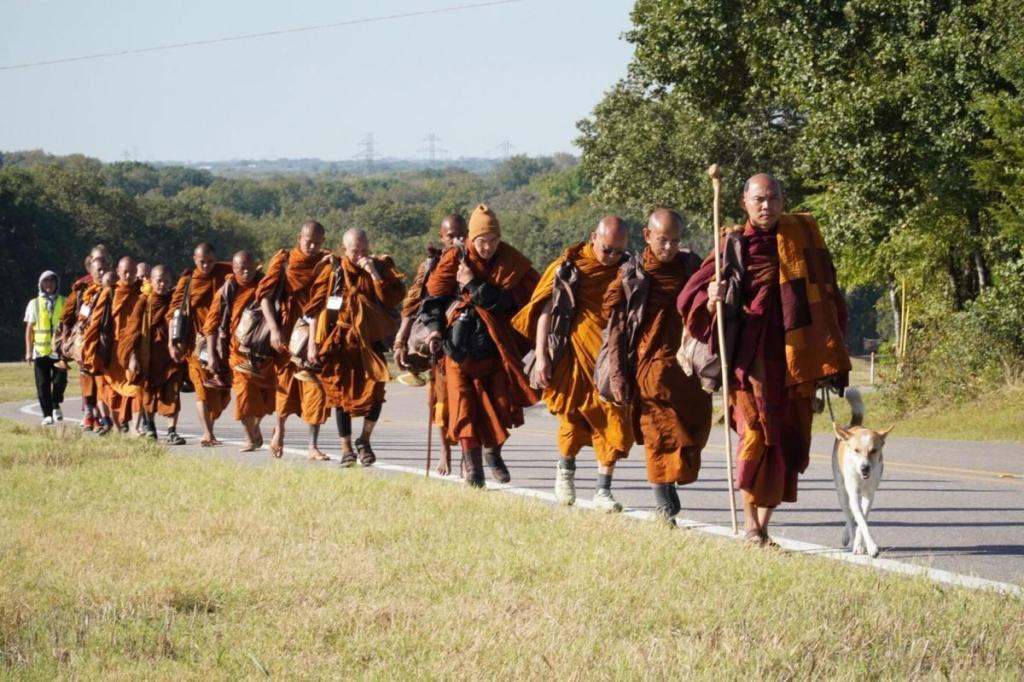
    These values are being lived – quite literally – by a group of Buddhist monks currently undertaking Walk for Peace, a 120-day, 2,300-mile walking pilgrimage from Fort Worth, Texas, to Washington, D.C. Their journey is not political, loud, or confrontational. It is quiet, prayerful, and embodied. They walk as a spiritual practice – one step at a time – carrying peace into each town and city they pass through.

    During this pilgrimage, tragedy struck. The group was hit by a vehicle. One monk lost his leg; another was injured. And yet, the walk did not end. In a response that feels both impossible and deeply human, the monks chose to continue – not with bitterness or retaliation, but with renewed commitment to compassion, resilience, and non-hatred.

    They do not protest. They do not argue. They do not demand attention. Instead, they walk mindfully, relying on generosity and community support, accompanied by their dog, Aloka. Their presence becomes the message. Peace is not explained – it is practiced.

    There is something quietly instructive here. In a world that often meets suffering with anger or division, these monks offer another way: to remain grounded, compassionate, and awake – even when life wounds deeply. Their walk reminds us that peace is not an idea we debate, but a posture we choose, again and again, with our bodies, our hearts, and our steps.

    What small choice today could become a step toward peace for you – in how you move, speak, or respond?

  • Nurturing Yourself Through Seasonal Illness

    Nurturing Yourself Through Seasonal Illness

    Gentle care for seasonal sickness

    After a second bout of COVID, I was reminded of something simple but easy to forget: our bodies speak – and when they do, they’re asking for kindness, not productivity.

    Seasonal sickness is inevitable. Colds, flu, lingering viruses – they arrive whether we plan for them or not. And while we often want to push through, these days invite us to tend, not conquer.

    Here are a few gentle ways to move through sick days with care and grace.


    🕯️ 1. Let Rest Be the Assignment

    This is not the season for catching up or powering through. Rest is not a reward – it’s part of healing. Quiet, naps, and stillness allow the body to do its unseen work.


    🍲 2. Simple Chicken Soup for Weak Days

    This is less a recipe and more a method – forgiving, nourishing, and easy.

    Simple Healing Chicken Soup

    • Chicken broth (homemade or good-quality store bought)
    • Cooked chicken (rotisserie works beautifully)
    • Carrots, celery, onion
    • Garlic (as much as feels good)
    • Salt, pepper, and a pinch of thyme

    Simmer gently until everything is soft and comforting. This kind of soup doesn’t rush – it waits for you.


    🍵 3. A Gentle Tea for Comfort & Congestion

    A warm mug can feel like medicine all on its own.

    Soothing Tea Blend

    • Chamomile (calming, comforting)
    • Ginger (warming, supportive)
    • Peppermint (helps breathing, eases the stomach)
    • A little honey, if desired

    Steep slowly. Sip slowly. Let warmth do what it does best.


    🌿 4. Simple Herbal Supports

    Nothing fancy – just gentle allies:

    • Elderberry for immune support
    • Ginger for warmth and circulation
    • Garlic for its natural protective properties
    • Thyme for coughs and chest comfort

    Use what you already have. Healing doesn’t need to be complicated.


    🕊️ 5. Release the Pressure

    Illness has a way of stripping life down to essentials. On these days, enough looks different – and that’s okay. The emails can wait. The world will keep spinning. Your job is to heal.


    There is grace even here – in cancelled plans, in slow mornings, in bowls of soup and quiet prayers whispered between naps. Sometimes healing is not about getting back to life quickly, but about letting life hold us gently until we’re ready to return

    When your body asks you to slow down, what helps you feel most cared for – physically or spiritually?

    “For everything there is a season, a time for every activity under heaven.”
    — Ecclesiastes 3:1 (NLT)

  • Understanding Grace: A Biblical Perspective on Rejoicing

    Understanding Grace: A Biblical Perspective on Rejoicing

    Grace is not a small or quiet thing in Scripture. In Romans 5, Paul tells us that grace does more than save us – it reorients what we rejoice in.

    Because of Christ, we are no longer enemies brought near by our own effort. “While we were still sinners, Christ died for us.” Grace is God’s initiative, not our achievement. And because of that, our rejoicing is not rooted in self-confidence, but in His work alone.

    Paul uses a word that feels almost startling: to boast.

    The Greek word kauchēma (kow-khay-mah) means to glory in, to rejoice over, to take pride in. It’s not the loud, self-centered boasting we often think of but a settled confidence that rests in something sure. Grace gives us something holy to boast in: what Christ has done, not what we have accomplished.

    This kind of rejoicing doesn’t ignore suffering or sin. It looks directly at them and still stands firm.

    James echoes this posture when he writes, “Consider it pure joy whenever you face trials of many kinds” (James 1:2). That word joy comes from chara (khar-ah), meaning deep gladness, great joyfulness. It’s not a denial of pain, but a trust that God is present and working within it.

    James also warns of a divided heart – a double-mindedness that keeps us unstable (James 1:8). Grace invites us into wholeness. It calls us to live with one steady gaze: not fixed on the chaos of the world, but on the faithfulness of God.

    And yes – we live in a world saturated with sin, confusion, and noise. But grace is not weakened by darkness. Paul reminds us that where sin increased, grace increased all the more. Grace does not excuse sin – it overcomes it.

    For the believer today, living in grace looks like this:

    • Rejoicing without pretending life is easy
    • Boasting only in the Lord’s mercy, not our own strength
    • Choosing joy that is rooted, not reactive
    • Remaining tender-hearted without becoming double-minded

    Grace teaches us how to stand – humble, confident, and deeply anchored in a broken world.

    This is the quiet beauty of grace: it doesn’t make us loud; it makes us secure.

    Lord,
    Thank You for grace that met us when we were far off
    and continues to meet us each day where we are.
    Teach us to rejoice not in ourselves,
    but in Your mercy, Your faithfulness, and Your finished work.

    In a world filled with noise, temptation, and division,
    anchor our hearts in truth.
    Help us live with steady joy – not shallow happiness,
    but the deep joy that comes from trusting You.

    May our lives quietly boast in what You have done,
    and may grace shape how we walk, speak, and love.
    We rest in You today.
    Amen.

  • Walking with Jesus: Faith Grows Through Curiosity

    Walking with Jesus: Faith Grows Through Curiosity

    Curiosity is often where faith begins. Not with certainty. Not with all the answers. But with a quiet wondering. Who is Jesus, really? If you find yourself asking that question, even softly, you are not alone. Luke shows us that many who encountered Jesus were unsure, searching, and still learning what it meant to follow Him.

    In Luke 9, Jesus sends out His disciples with almost nothing. No extra supplies. No safety net. It’s an unsettling way to begin, especially for those of us who crave clarity before commitment. Yet Luke the Evangelist reveals something important: trust is not formed before the journey – it is formed while walking it. For those who are curious about Jesus but hesitant to fully believe, this can be reassuring. Faith is not a prerequisite for the journey; it often grows along the way.

    Later, a large crowd gathers, hungry and uncertain. The disciples see scarcity – too many people, too little food. But Jesus sees possibility. With a small offering placed in His hands, abundance follows. This moment speaks gently to those who feel they don’t have enough to offer – enough belief, enough understanding, enough goodness. Luke reminds us that Jesus does not ask for perfection. He asks for honesty. What feels insufficient in our hands can become more than enough when surrendered.

    Then Jesus asks a question that lingers: “Who do you say I am?

    This is not a test. It is an invitation. Some answer with confidence. Others with confusion. Some are not ready to answer at all. And still, Jesus continues walking with them. Grace is present long before certainty ever arrives.

    When Jesus speaks about taking up the cross and following Him, His words can feel heavy – especially to those who have been hurt by rigid or fear-based faith. But in Luke, this call is not about losing ourselves; it is about discovering a truer way to live. Jesus invites us out of self-protection and into trust, out of control and into relationship. He never forces belief. He invites participation.

    What stands out most in Luke is Jesus’ posture. He feeds the hungry. He welcomes questions. He walks patiently with imperfect people. He does not demand immediate understanding or flawless faith. He offers presence.

    If you are curious about Jesus, you do not need to rush toward conclusions. You can linger. You can question. You can observe. You can simply stay near the story and notice what stirs in your heart. Many of those closest to Jesus began exactly there- watching, listening, wondering.

    Faith rarely begins with certainty. More often, it begins with a quiet maybe.

    And Luke reminds us that even this is enough to begin.

    If you are curious about Jesus, you are not outside the story. You are standing at the doorway of an invitation – one marked by patience, compassion, and grace. And Jesus is not asking you to have it all figured out. He is simply inviting you to walk with Him, one gentle step at a time.

    At the heart of all that happens in Luke, we are left with a quiet invitation that meets us in the everyday.

    “Whoever wants to be my disciple must deny themselves and take up their cross daily and follow me.’”
    Luke 9:23

    With love, from the porch,
    Laura

  • The Gift of Hunkering Down

    The Gift of Hunkering Down

    There is something sacred about the first real cold snap of winter.
    The kind that makes you pull your sweater a little tighter.
    The kind that sends you searching for that favorite blanket.
    The kind that whispers, slow down now.

    Winter never apologizes for asking us to hunker down. It simply arrives, quiet and insistent, and extends an invitation we didn’t even know we needed: to turn inward, to rest, to be still.

    The Quiet Permission of Winter

    Our world rarely gives us room to withdraw, to cocoon, or to let the rhythm of our days match the shorter light and longer nights. Yet winter offers this permission freely if we choose to receive it.

    When the cold settles in and the world outside grows hushed, something in us remembers an older rhythm. A rhythm that knows rest is not laziness. A rhythm that understands that some of the most important work happens in the quiet.

    What Fills the Soul in Winter

    So what do we do with these cold, cozy days? What truly nourishes us when we hunker down?

    We light candles and watch the flame dance. There is something nearly prayerful about it – how the steady glow pushes back the darkness.

    We wrap our hands around warm mugs. Coffee in the morning, tea in the afternoon, cocoa in the evening. Each one a small ceremony of comfort, steam rising like our unspoken prayers.

    We finally pull out the books we’ve been meaning to read. We get lost in stories, or found in the words of poets and wise guides.

    We cook slow meals that warm the whole home. Soup simmering all afternoon. Bread rising on the counter. Food that quietly says you are loved, you are cared for, you are home.

    We create with our hands. Knitting, drawing, writing, building – whatever allows the soul to speak without words.

    We sit in the silence and simply breathe. We hear the wind at the windows. We watch the snowfall if we are blessed with it. We let ourselves be still, without agenda or achievement.

    The Deeper Invitation

    But winter isn’t only inviting us to cozy moments. It is calling us deeper.

    It reminds us that we too are part of creation’s rhythms. That we need seasons of dormancy and rest. That sometimes growth happens underground, in the dark, where no one can see.

    Winter asks gentle questions.
    What needs to fall away?
    What needs to rest?
    What is God nurturing in you that is not yet ready to bloom?

    These cold months give permission to let some things lie fallow. To stop striving. To trust that spring will return, but for now, this stillness is exactly where you are meant to be.

    A Prayer for the Cold Days

    For the shortened days and lengthened nights,
    For the cold that sends us seeking warmth,
    For the quiet that settles over everything,
    Thank You.

    Teach us to hunker down without guilt.
    To rest without apology.
    To find You in the stillness,
    In the candle’s glow,
    In the steam rising from our cups,
    In the peace of simply being held.
    Amen.

    As the cold weather settles in around you, I hope you’ll accept winter’s invitation. Pull on your coziest socks. Light a candle. Make a slow, comforting meal. Open a good book. And remember that in the hunkering down, your soul is being tended.

    You are exactly where you need to be.

    What will you do this winter to fill your soul?


    Soul-Warming Chicken Soup

    Speaking of slow meals, here is a simple, forgiving chicken soup that fills the house with warmth. It tastes like comfort and makes the whole home smell like a hug.

    Ingredients:

    2–3 lbs bone-in chicken pieces (thighs and breasts work beautifully)- a rotisserie chicken works well too
    8 cups organic chicken broth
    3 carrots, peeled and sliced
    3 celery stalks, chopped
    1 large onion, diced
    3–4 cloves garlic, minced
    2 bay leaves
    1 teaspoon dried thyme (or a few fresh sprigs)
    1 teaspoon dried parsley
    Salt and pepper to taste
    1 ½ cups egg noodles or your favorite pasta
    Fresh lemon juice (optional, but lovely)
    Fresh dill or parsley for serving

    Instructions:

    1. In a large pot, add the chicken, broth, bay leaves, and a generous pinch of salt. Bring to a gentle boil, then reduce heat and simmer 45–60 minutes, until the chicken is tender.
    2. Remove the chicken and set aside to cool. Leave the broth simmering.
    3. Add the carrots, celery, onion, garlic, thyme, and parsley. Simmer about 20 minutes, until everything is tender.
    4. Shred the cooled chicken, removing skin and bones. Add the meat back to the pot. If you are using a rotisserie chicken, it’s a much easier process as it is already cooked and will just need shredding!
    5. Add the noodles and cook according to package directions.
    6. Taste and adjust seasoning. Add lemon juice if you like a bright finish.
    7. Serve warm with fresh herbs and crusty bread or in a bread bowl. My favorite bread bowls are from the Healing Slice website.

    A little note: it tastes even better the next day. 📖☕

    “Winter is the season when warmth comes from within.” 🕯️

    With love, from the porch,
    Laura

  • Light in the Darkness: Advent’s Message of Compassion

    Light in the Darkness: Advent’s Message of Compassion

    Advent always begins softly, arriving like a gentle breath after a long season. As we step into this time of reflection, I’ve been spending time with Howard Thurman’s book Jesus and the Disinherited. His reminder is clear and powerful: Jesus came for those with their backs against the wall. For the overlooked, the weary, the misunderstood, and the ones pushed quietly to the edges of society.

    Surprisingly, this same theme appears in the story of Wicked. Beneath the music and color is a tender message about judgment, fear and the way a person can be labeled without ever being truly known. Elphaba isn’t wicked. She is wounded and misunderstood, living in a world that never paused long enough to see her heart. She represents anyone who has carried the weight of being misread or marginalized.

    Thurman points us toward the same truth. Jesus’ life and ministry were not centered around the powerful. They were rooted in compassion for the vulnerable, the rejected and the unseen. Advent becomes a season of remembering that God chose to enter the world through humility and vulnerability. Born into a family without status, without safety and without a place to stay, Jesus came in solidarity with those who know what it feels like to have no room.

    If this season feels complicated for you, you are not alone. Many people enter December carrying grief, uncertainty, loneliness or a deep sense of not fitting into the rhythms of celebration around them. Advent speaks directly to that experience. It tells us that hope comes especially to those who feel out of place. It tells us that God draws close to the misunderstood. It tells us that the love of Christ shines gently on every heart that feels pressed against the margins.

    The stories of the disinherited and of Elphaba remind us of something important. What the world overlooks, God holds close. What the world labels, God understands. What the world wounds, God longs to heal.

    As we light the first Advent candle, may this small flame remind us that hope often begins quietly. It arrives for the weary, the searching, and the ones longing for a place to rest.

    Where in your life do you feel unseen, misunderstood or pushed to the margins?

    How might God be drawing close to you in that very place?

    Who around you might need a little extra compassion this season?

    Lord, as the season of Advent begins, meet us in the tender spaces of our lives.
    Shine Your gentle light on every place that feels misunderstood or overlooked.
    Teach us to see the quiet stories unfolding in the hearts of those around us.
    Help us offer compassion, patience and understanding in Your name.
    May this season draw us closer to Your heart and closer to one another.
    Amen.


  • Thanksgiving Reflection 🍂

    Thanksgiving Reflection 🍂

    Thanksgiving has a way of stirring up so many layers in us.
    For some, it’s a day wrapped in warmth, familiar recipes, and the comfort of gathering.
    For others, it’s a day that carries an ache – the empty chairs, the strained relationships, the quiet griefs, the memories that sit just beneath the surface.

    If this holiday feels complicated for you in any way, you are not doing it wrong.
    You are simply human.
    And your heart is welcome here.

    Today on the porch, we make room for both:
    the gratitude and the heaviness,
    the abundance and the longing,
    the laughter and the quiet tears that come when no one is looking.

    Whatever this day feels like for you – joyful, heavy, peaceful, or somewhere in between – may you know that your feelings deserve gentleness, not judgment.

    Sometimes gratitude doesn’t sound like a long list.
    Sometimes it’s just a single breath:
    “Thank You, God, for getting me through today.”
    And that is enough.

    Sometimes grace looks like stepping away from loud rooms to regroup.
    Sometimes it looks like saying no.
    Sometimes it’s choosing the smallest, kindest next step.

    Wherever you are, I pray this for you:


    God, gather us gently today.
    Hold the ones who celebrate with joy,
    and hold the ones who feel the weight of this season.

    For those who are missing someone,
    wrap them in a peace that softens the sting of absence.

    For those walking through family tension,
    give them courage, calm, and the freedom to protect their heart.

    For those who feel lonely or overlooked,
    remind them they are seen, valued, and deeply loved.

    For the ones overwhelmed, grieving, tired, or unsure,
    shine light into the places that feel dim.
    Give them rest, and show them the small mercies tucked into the day.

    And for all of us —
    teach us to slow down, breathe deep,
    and receive Your goodness in whatever way we’re able today.

    Amen.

  • Easy Guide to Gluten-Free Sourdough Starter

    Easy Guide to Gluten-Free Sourdough Starter

    There’s something so grounding about creating a sourdough starter from scratch – especially one that’s gluten-free and filled with the goodness of simple, wholesome grains. It’s one of those quiet kitchen rituals that reminds us how patient, slow work brings life and nourishment.

    If you’ve been wanting to bake gluten-free sourdough at home, this little guide will walk you through those first seven days with ease and encouragement. The ingredients are humble, the process is simple, and by the end of the week you’ll have a lively, bubbly starter ready to bless your baking.


    🌱 Ingredients

    Choose one flour or mix a blend you enjoy:

    • Oat flour
    • Buckwheat flour
    • Brown or white rice flour
    • Sorghum flour

    And:

    • Filtered water (this is important—chlorine can hinder wild yeast growth)

    🥣 Day-by-Day Instructions

    Day 1: Mix Flour & Water

    • Combine ¼ cup gluten-free flour with ¼ cup filtered water.
    • Stir vigorously, scraping down the sides.
    • Cover with a clean tea towel and let rest for 24 hours.

    Day 2: Discard & Feed

    • Discard half of your starter.
    • Add ¼ cup flour + ¼ cup water.
    • Stir well and cover.
    • Rest for 24 hours.

    Days 3, 4 & 5: Repeat the Daily Rhythm

    • Each day, discard half.
    • Feed with ¼ cup flour + ¼ cup water.
    • Cover and let rest another 24 hours.

    Days 6 & 7: Increase Feeding to Every 12 Hours

    • Continue the same discard + feed routine, but now do it twice per day.
    • By Day 7, your gluten-free starter should be lively, bubbly, and ready to bake with.

    📝 Notes & Helpful Tips

    • Gluten-free starters can take a little longer to get bubbly -especially if using buckwheat. Don’t lose heart! Consistency is key.
    • I personally like using oat flour and sorghum flour -they create a mild, pleasant starter.
    • Filtered water is best. Tap water with chlorine can slow or prevent the natural fermentation process.
    • Keep your starter somewhere warm (around 70–75°F if possible).

    🍞 Helpful Tools for Gluten-Free Sourdough

    Below are some tools I use and love. They make the sourdough process easier, cleaner, and more enjoyable.


    A Gentle Thought for the Journey

    There’s such a tender reminder in sourdough: growth happens quietly, steadily, and often unseen. All we’re asked to do is show up with consistency and care, trusting something beautiful is forming beneath the surface.

    May this little starter bring warmth to your kitchen and joy to your home.


    Affiliate Disclosure

    As an Amazon Associate, I earn a small commission from qualifying purchases at no extra cost to you. Thank you for supporting The Prayer Porch and the work that goes into each post 🌿

  • God’s Promise: Life from the Valley of Dry Bones

    God’s Promise: Life from the Valley of Dry Bones

    There’s a moment in the book of Ezekiel that feels as honest as any human experience: the valley of dry bones. God leads Ezekiel into a place filled with what once had been alive – scattered remains, brittle and silent. Then God asks him, “Son of man, can these bones live?”

    Ezekiel answers the only way he can: “Lord, You alone know.”
    It’s a whisper of faith from someone staring at something that looks completely hopeless.

    We all have seasons like that.
    Times when our hearts feel tired and our purpose feels distant.
    Our prayers feel like they echo in an empty valley.

    There are days we wake up and feel hollowed out by stress, disappointment, grief, or sheer exhaustion. Moments where we feel spiritually thin – like the “us” we used to be has slipped away.

    And just like those dry bones, we wonder if anything can live again.

    But God speaks into that emptiness. He tells Ezekiel to prophesy to the bones, to call them to hear the word of the Lord. And as Ezekiel speaks, something miraculous happens:

    Bone begins to find bone.
    Sinews and flesh form.
    And finally, God breathes His Spirit – the holy breath – into them.
    And where death once lay, a living army rises.

    This story is more than an ancient vision; it’s a promise.

    🌬️ God still breathes life into the dry places.

    Into the places we’ve abandoned.
    Into the wounds we’ve tried to hide.
    Into the dreams we let go of because we were too tired to keep hoping.

    What does this look like in daily life?

    Sometimes it’s the moment you feel a spark of purpose after weeks of numbness.
    Sometimes it’s a gentle conviction “Call that person – try again – pray one more time.”
    Sometimes it’s the strength to get out of bed with a fresh sense of “maybe today.”
    Sometimes it’s tears that finally fall, clearing the ground for healing.
    Sometimes it’s a reminder that God isn’t finished with your story.

    Life returning doesn’t always come as a thunderclap.
    Most of the time, it comes as a quiet stirring.
    A small breath.
    A whisper that says, “I am with you.”

    As the world around us settles into rest, maybe we can sit on the porch with this gentle truth:

    God never leaves us in the valley.
    He meets us there.
    He speaks to the bones.
    And He breathes new life into what we thought was over.


    Lord, breathe life into the dry places within me.
    Restore what has grown weary.
    Reconnect what has been scattered.
    Revive what feels lost or forgotten.
    Help me trust that no valley is too empty for Your Spirit to fill.
    May Your breath bring strength, hope, and a fresh beginning today.
    Amen.