What Martin Luther’s 95 Theses Still Say to Us Today
Ephesians 2:8-9 “For it is by grace you have been saved, through faith and this is not from yourselves, it is the gift of God not by works, so that no one can boast.”
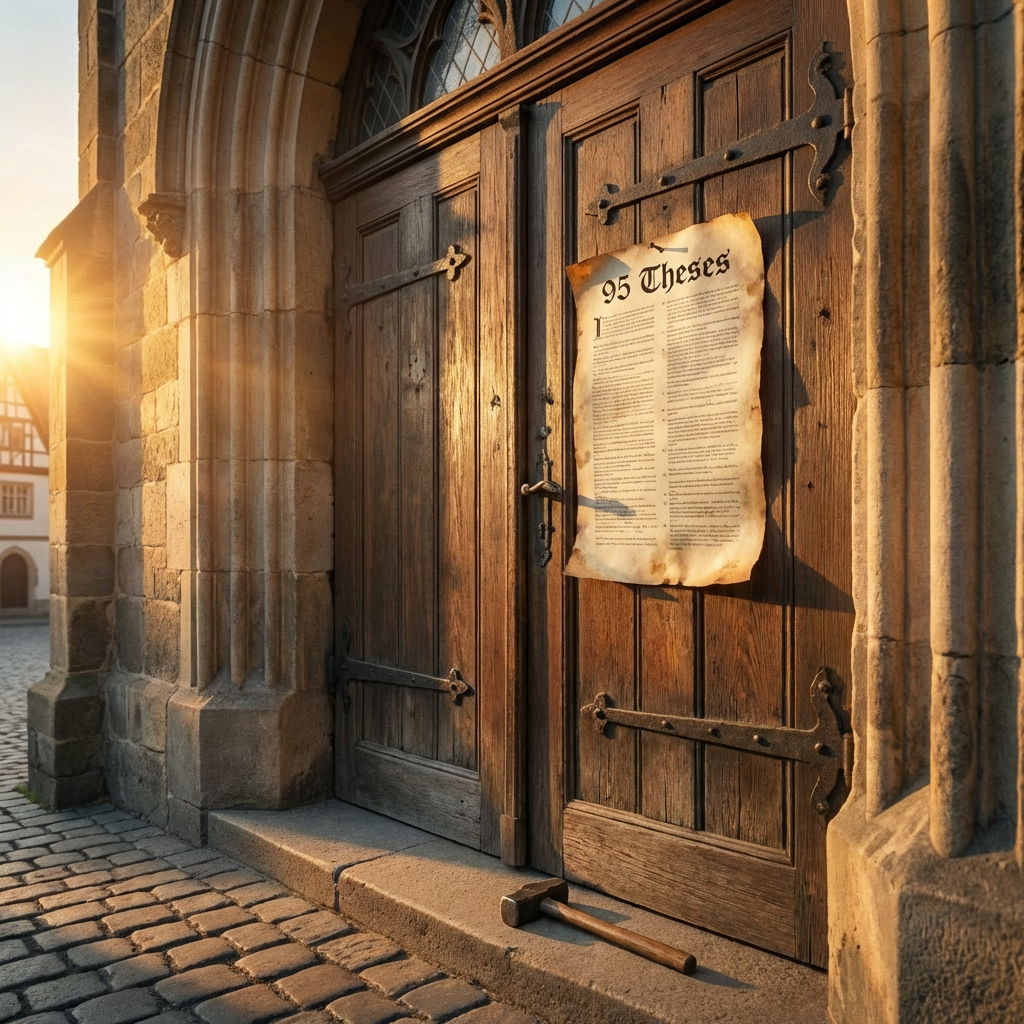
On the morning of October 31, 1517, an Augustinian monk and theology professor walked to the door of the Castle Church in Wittenberg, Germany, and nailed a document to it.
He was not trying to start a revolution.
He was inviting a debate.
What followed changed the course of Christianity forever.
Who Was Martin Luther?
Martin Luther was a devout Catholic priest and university professor who loved God deeply and took Scripture seriously. He was not a rebel by nature. He was, by most accounts, a man tormented by his own unworthiness before a holy God, searching desperately for assurance of grace.
What he found in Scripture disturbed him profoundly. Not because the Word was troubling, but because what the church was teaching and what the Word actually said were two very different things.
And nowhere was that gap more visible than in the selling of indulgences.
What Were Indulgences?
In the medieval Catholic Church, indulgences were documents – literally purchased certificates that were said to reduce the punishment a person (or their deceased loved one) would face for sin. The idea was that the church held a treasury of merit, accumulated by Christ and the saints, and the Pope had the authority to distribute it.
For a price.
A friar named Johann Tetzel was traveling through Germany at the time with a memorable sales pitch, essentially telling people they could buy their loved ones out of purgatory. The money was being used to fund the construction of St. Peter’s Basilica in Rome.
Luther was horrified.
The 95 Theses – What They Actually Were
The document Luther posted was formally titled Disputation on the Power of Indulgences. It contained 95 propositions – not 95 separate grievances, but 95 interlocking arguments building toward a single conclusion: the church had wandered far from Scripture and was exploiting ordinary believers.
Written in Latin in the style of academic debate, Luther was initially inviting fellow scholars to discuss and push back. But when his theses were translated into German and carried on the newly invented printing press, they spread across Europe within weeks. What began as a professor’s debate document became the spark of the Protestant Reformation.
Here is what Luther argued, in plain terms:
On Repentance: True repentance is an inward, lifelong transformation not an outward act that can be purchased. God alone can remit guilt.
On Indulgences: Indulgences do not save souls. They only remit church-imposed penalties. Selling them gives people a dangerous and false sense of security about their standing before God.
On Purgatory: Luther challenged the Pope’s claimed authority over purgatory directly asking, if the Pope truly had the power to release souls, why would he not do so freely, out of love, rather than for payment?
On the Poor: Some of Luther’s most pointed arguments were on behalf of ordinary people. He condemned the practice of taking money from the poor to build St. Peter’s Basilica in Rome, arguing that the Pope, one of the wealthiest men in the world, had no business burdening the poor for a building project.
On the Gospel: Here is where Luther’s heart was most fully on display. The church’s true treasure, he wrote, is not indulgences. It is the gospel. And the gospel is not for sale.
What This Still Means for Us
Luther was not simply arguing about church policy. He was arguing about the nature of grace itself.
If grace can be purchased, it is not grace. If forgiveness must be earned through payment, through performance, through accumulating enough religious merit, then the cross accomplished nothing. Then Christ’s words it is finished were not finished at all, only partially complete, waiting for our contribution to make up the difference.
This is what Paul was writing against in Ephesians 2. It is the gift of God, not by works, so that no one can boast. Grace, by definition, cannot be bought. The moment a price tag is attached, it becomes something else entirely.
Luther saw ordinary people – poor, grieving, desperate – handing over money they did not have for an assurance that was never theirs to sell. And he could not stay silent.
The Courage of an Ordinary Moment
We sometimes imagine Luther as a bold revolutionary, striding confidently toward the church door with hammer in hand. The historical reality is more human than that. He was a man wrestling deeply with his own sin and inadequacy, who had found in Scripture a grace so free and so complete that he could not watch it be corrupted without saying something.
He did not know what would happen next. He simply knew what was true.
There is something worth sitting with in that. Most of us will never nail anything to a church door. But we will have moments when we know what is true, and when staying silent feels safer than saying it.
Luther’s example reminds us that faithfulness to the gospel sometimes looks like ordinary courage – one document, one door, one reluctant act of obedience to what Scripture clearly says.
Lord, we are grateful that grace is not for sale. That there is no treasury of merit we must purchase from, no certificate that can stand in for the work You already completed on the cross. Forgive us for the ways we have treated Your grace as something to be earned – through enough effort, enough goodness, enough religious activity. Remind us today that it is finished. That You gave freely what we could never have afforded. And give us, like Luther, the quiet courage to hold fast to that truth even when it costs us something. Amen.
Leave a Reply